Categories
Blog

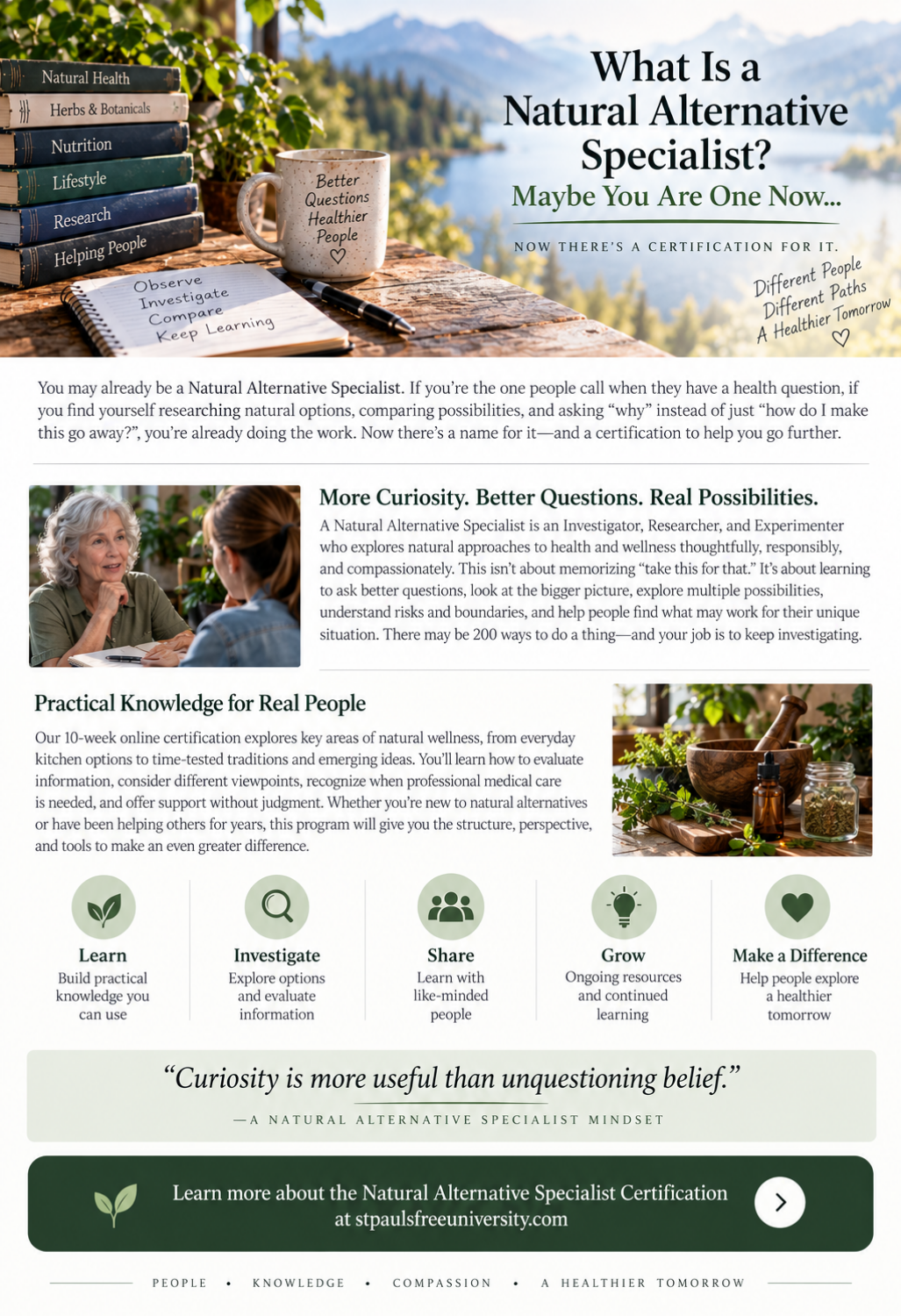
What Is a Natural Alternative Specialist? Maybe You Are One Now…

Now There’s a Certification for It.
You know who you are. Somebody mentions that they haven’t been sleeping well and your brain immediately starts turning. Magnesium? Stress? What are they eating before bed? Are they getting sunlight in the morning? What medications are they taking? When did this start?

You don’t necessarily tell them any of that. But you’re curious.

Someone complains about their stomach and instead of immediately thinking: “What makes stomach pain go away?”

you wonder: “What’s making their stomach hurt?”

Someone tells you what worked for them and you go home and research it. Then you find six other approaches. Then somebody tells you about a seventh. Before you know it, you’ve fallen down another natural-health rabbit hole and it’s two o’clock in the morning.

Welcome.

You may already be a Natural Alternative Specialist.

You Don’t Need to Know Everything

Let’s get this out of the way immediately. You will never know everything about natural alternatives. Neither will we.

That’s actually one of the ideas behind the new Natural Alternative Specialist Certification.

There isn’t one book containing all the answers. There isn’t one perfect protocol. There isn’t one herb. One supplement. One diet. One practitioner. Or one philosophy that owns wellness.

Spend enough time in this field and you’ll discover:

There are 200 ways to do a thing.

Maybe not literally 200. Sometimes there might be 2,000. The point is that our job isn’t to memorize every answer. Our job is to become better at finding possibilities.

From Kitchen Cabinets to Controversial Alternatives

We’re going to cover a lot of territory. Some weeks we’ll investigate things so ordinary that they’re probably sitting in your kitchen right now. Other weeks we’ll venture into areas of natural and alternative health that generate considerably more debate. Good.

We don’t need to be afraid of controversial information. We need to learn how to examine it.

Over ten weeks, we’ll explore areas involving microbes and contamination, magnesium, DMSO, Silver Water, castor oil, parasites and deworming, supermarket remedies, nutrition, lifestyle, and much more.

But here’s an important distinction:

This isn’t going to be ten weeks of product pitches.

Each featured natural alternative is a doorway into a much larger conversation.

If we’re talking about magnesium, we’re really talking about things like muscles, nerves, relaxation, sleep, nutrition, and the body’s need for minerals.

If we’re talking about castor oil, we’re opening conversations about digestion, elimination, topical traditions, and natural body rhythms.

If we’re talking about Silver Water, we’re entering a much larger world involving silver, microbes, historical use, contemporary research, field experience, and differing preparations. The product is the starting point.

The human body is the subject.

We’re Going to Ask Better Questions

This may be the biggest difference between collecting natural remedies and becoming a Natural Alternative Specialist.

Someone tells you: “My hip hurts.”

You don’t immediately reach into your bag and announce:

“I HAVE THE THING!”

Slow down.

  • When did it start?
  • Was there an injury?
  • What makes it better?
  • What makes it worse?
  • What else changed around the same time?
  • What’s happening with movement?
  • Nutrition?
  • Sleep?
  • Inflammation?
  • Medications?
  • Previous diagnoses
  • What has already been investigated?
  • Is there something here that needs professional medical attention?

The goal isn’t to demonstrate how much you know.

The goal is to become curious enough to discover what you don’t know.

Your Experience Counts—But It Isn’t Everybody’s Answer

Natural-health communities are filled with extraordinary stories.

Somebody was terribly sick. They discovered something. Their life changed. Naturally, they became enthusiastic. Personal experience matters. But we’re also going to practice humility.

If something changed your life, tell your story. Just remember:

Your testimony is an invitation, not an obligation.

Someone else may choose another path. Let them. Someone may trust their physician more than they trust natural alternatives. Love them anyway.

Someone may ask one question about what you’re doing. Answer one question. Don’t chase them down the driveway with seventeen supplements and a three-ring binder.

We’re here to help people. Not convert them.

Natural Wellness Requires Participation

We’ll also talk about something natural-health advertising doesn’t always emphasize: This can take work.

Changing the conditions surrounding health may involve persistence.

  • Different food.
  • Different habits.
  • Different schedules.
  • Movement.
  • Rest.
  • Supplements taken consistently.
  • Tracking results.
  • Research.
  • Testing when useful.
  • Changing course when something isn’t working.
  • Sometimes even changing significant parts of your life.

Because if you improve your health and then rebuild precisely the same conditions that surrounded the old problem, you shouldn’t automatically be surprised if old patterns return.

Natural wellness isn’t always about finding something magical to swallow. Sometimes it’s about becoming somebody who lives differently.

And Sometimes the Grocery Store Is Enough

Not everything we’ll study is exotic. In fact, one of the classes I’m particularly looking forward to is what we’re calling:

Supermarket Medicine

Walk through an ordinary grocery store with enough historical and natural-health knowledge and it starts looking very different.

  • Foods.
  • Spices.
  • Herbs.
  • Salts.
  • Oils.
  • Teas.
  • Minerals.
  • Honey.
  • Ginger.
  • Garlic.
  • Baking soda.

And dozens of other ordinary things people have used for generations.

You don’t necessarily need an obscure website and a $129 bottle to begin learning about natural wellness. Sometimes you need a grocery cart.

We’re Building This Together

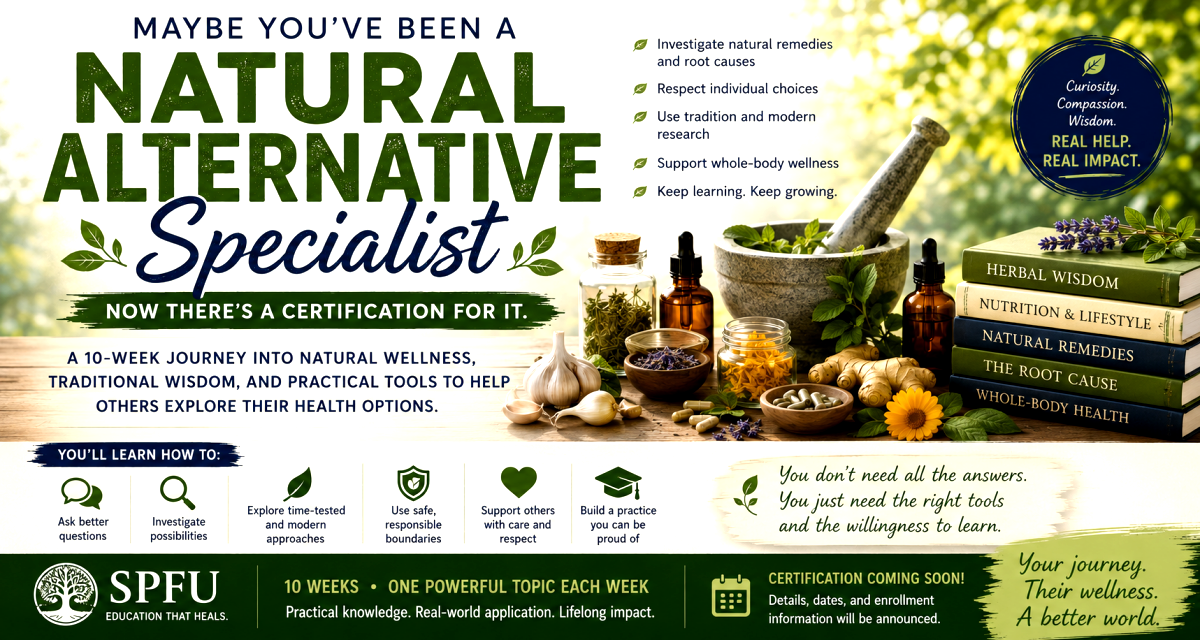
The Natural Alternative Specialist Certification is being developed now as a 10-week program. And the goal isn’t simply to add another certificate to someone’s wall.

We want to develop people who are:

  • Curious enough to investigate.
  • Humble enough to keep learning.
  • Wise enough to recognize their boundaries.
  • Careful enough to consider risks.
  • Confident enough to share what they know.
  • Compassionate enough not to force it on anybody.

That’s the kind of Natural Alternative Specialist we’d like to send into the world.

Maybe you’ve been one for years. You just didn’t have a name for it. Now you do.

Natural Alternative Specialist

And soon, you’ll have an opportunity to become certified.

Stay close.

We’re just getting started.

Categories
Blog

There Are 200 Ways to Do a Thing: Find What Works for Your Health

Finding something that worked doesn’t mean you’ve found the only thing that works. Something happens when people experience a dramatic improvement in their health. They get excited. Of course they do.

Imagine being told you’re facing a terrible prognosis. Imagine living with something you’ve been told is chronic, progressive, or unlikely to improve. Then you begin doing something different.

  • Maybe you dramatically change your diet.
  • Maybe you begin using an herb.
  • Maybe it’s a nutritional protocol.
  • Maybe it’s a medical treatment.
  • Maybe it’s a natural-health regimen.
  • Maybe you change twelve things simultaneously and have absolutely no idea which one mattered most.

But something happens. Your health improves. Perhaps dramatically. And suddenly you want to stand on a chair and announce:

“THIS IS IT!”

“I found it!”

“This is the answer!”

“This is the cure!”

I understand that enthusiasm. But after spending enough time around natural-health people, you eventually discover something humbling:

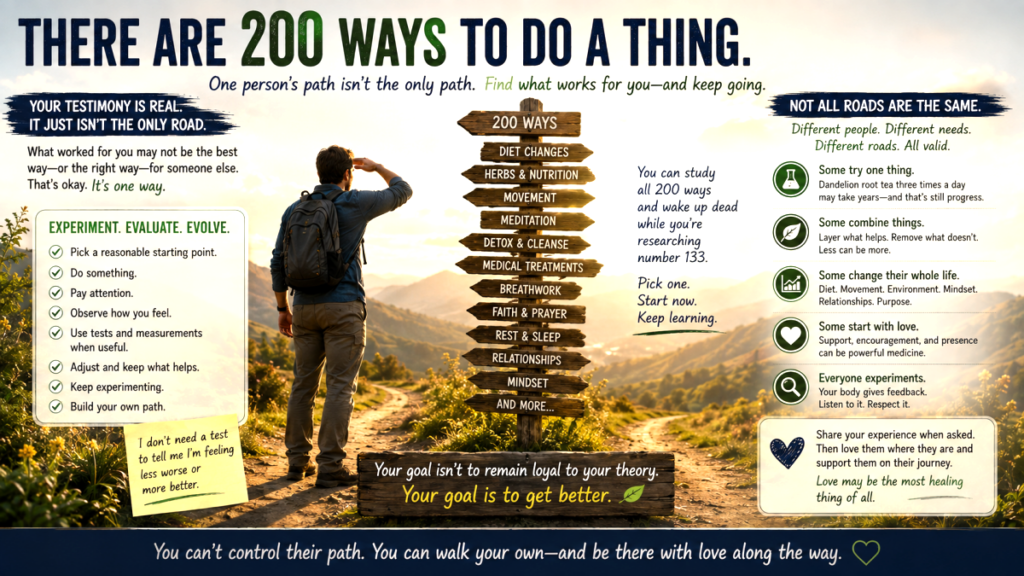
There are 200 ways to do a thing.

Your Testimony Is Real. It Just Isn’t Everybody’s Road Map.

Suppose you’ve experienced something extraordinary.

  • Your doctors gave you a frightening prognosis.
  • You went home.
  • You investigated.
  • You made changes.
  • Months or years later, you’re doing remarkably well.

That’s your story. Nobody needs to take that away from you.

  • If you experienced it, you experienced it.
  • If your laboratory results changed, they changed.
  • If imaging changed, it changed.
  • If your symptoms disappeared, that’s what happened.
  • If you’re still standing ten years after somebody predicted you wouldn’t be, you’re entitled to be rather enthusiastic about that.

But there’s a subtle leap we sometimes make:

“This worked for me.”

becomes:

“This works.”

And then:

“This is what everyone with this condition should do.”

Those are three different statements.

Your experience may have discovered one road. It doesn’t necessarily mean you’ve discovered the only road. And here’s an even more humbling possibility:

Your road might not even be the best road.

It may simply be the road you found. That’s okay. A road that gets you somewhere is still enormously valuable.

One Successful Experiment Should Make Us Curious

I actually think a successful personal experiment should make us more curious, not less.

Suppose someone drinks dandelion-root tea three times a day and over three years experiences the improvement they were hoping for.

Wonderful.

  • Could something else have produced the same result? Possibly.
  • Could another approach have done it in eighteen months? Maybe.
  • Could something have accomplished it in six months?

We don’t know.

  • Could the tea have been only one factor among several? Certainly possible.
  • Could the improvement have occurred for reasons the person never identified? Also possible.

None of those questions require us to ridicule their experience. They simply keep curiosity alive.

Natural health becomes much less interesting when discovery turns into dogma.

The Problem With “The One Thing”

Human beings love singular answers.

  • The food.
  • The herb.
  • The supplement.
  • The detox.
  • The exercise.
  • The protocol.
  • The doctor.
  • The molecule.
  • The cure.

One answer is comforting. Two hundred possibilities are messy. But biology is messy. Two people can receive the same diagnosis and have remarkably different histories.

  • Different genetics.
  • Different diets.
  • Different nutritional status.
  • Different microbiomes.
  • Different medications.
  • Different environments.
  • Different exposures.
  • Different stress loads.
  • Different ages.
  • Different sleep.
  • Different activity levels.
  • Different underlying conditions.
  • Different resources.
  • Different beliefs.
  • Different willingness to change.

Why would we automatically expect every one of those people to follow precisely the same path?

Don’t Study Yourself to Death

Now we reach the other extreme. Once you realize there may be 200 ways to approach something, you can become paralyzed by possibilities.

You read about approach number one. Interesting. Then number two contradicts number one. So you investigate number three. Someone says number four changed their life. But a podcast tells you number seven is better. Then you find an online group devoted to number twenty-three. A practitioner tells you they’re all wrong and you need number forty-eight. Six months later, you’ve created a spreadsheet comparing 132 approaches.

You’re about to begin investigating number 133. And you’ve done absolutely nothing. At some point:

DO SOMETHING.

You can spend all your time studying the 200 ways to do a thing and wake up dead while you’re researching number 133.

That’s deliberately provocative. But the point matters. Research is useful.

Research without action can become another form of avoidance.

Pick a Reasonable Starting Point

You don’t have to know the perfect answer before beginning. Find a reasonable starting point. Evaluate the risks. Understand what you’re doing. Consider interactions and contraindications.

For serious medical conditions, know what can be objectively monitored and involve appropriate professionals where needed.

Then begin.

Not twenty things at once if you can avoid it. Something.

Pay attention. Keep records. What changed? What didn’t? How do you feel? What are your measurements showing? Are your symptoms improving? Are there unwanted effects? Are objective markers changing? Does something need adjusting?

That’s experimentation.

Feeling Better Matters

I deliberately like saying things such as:

“I don’t need a medical test to tell me I’m feeling less worse or more better.”

Yes, I know. Less worse. More better.

I said it that way on purpose. Because subjective experience matters.

  • If you used to wake up exhausted and now you wake up refreshed, that’s information.
  • If climbing the stairs hurt and now it doesn’t, that’s information.
  • If you had headaches four days a week and haven’t had one in a month, that’s information.
  • If you couldn’t sleep and now you’re sleeping seven hours, that’s information.

Your experience of living inside your body counts. But it isn’t the only information available.

Sometimes the Body Whispers While the Numbers Scream

This becomes especially important with serious conditions.

  • You can feel perfectly fine while blood pressure is dangerously high.
  • Blood glucose can be moving in the wrong direction before you recognize obvious symptoms.
  • Some cancers can progress without announcing themselves through daily sensations.
  • Kidney and liver problems can develop quietly.

So when reliable objective measurements exist, use them. That’s not surrendering your natural-health independence. That’s gathering more data.

If I’m experimenting, I want more information, not less.

  • How do I feel?
  • What does my body seem to be telling me?
  • What does the laboratory work say?
  • What does imaging show when appropriate?
  • What changed before the improvement?
  • What changed before deterioration?

All of it becomes part of the investigation.

Listen to your body—and use instruments when your body can’t tell you the whole story.

Build Your Own Road Carefully

This is where natural wellness can become deeply personal.

Maybe you discover that changing your diet helps. Keep it. Then you add something else and notice additional improvement. Keep investigating.

Maybe movement makes another difference. Maybe correcting a nutritional deficiency changes something. Maybe an herb does. Maybe better sleep produces a bigger improvement than the expensive supplement you were convinced would save the world.

Maybe something you were excited about does absolutely nothing. Fine. Let it go. Your goal isn’t to remain loyal to your theory.

Your goal is to get better.

That distinction can save you enormous amounts of time and money.

Combination Doesn’t Automatically Mean Better

There is one caution here. Once natural-health people discover several promising things, there’s a temptation to combine everything. If one is good, twelve must be spectacular. Not necessarily.

Natural substances contain active compounds. Supplements can interact with one another. They can interact with medications. More isn’t automatically better.

And when you change fifteen things simultaneously, you may have no idea which one helped—or which one caused a problem.

Experimentation should include restraint.

Add thoughtfully. Observe. Document. Adjust.

Your 200 Ways Aren’t My 200 Ways

Now we return to something important from our previous conversation. Suppose you found your thing. You’re excited. You tell me. Wonderful. But maybe I’m investigating something else.

Don’t be offended. Your thing may not be on my radar. Maybe I’ve already considered it. Maybe I’m not comfortable with it. Maybe I’m working with somebody whose approach differs from yours. Maybe something else makes more sense to me. Or maybe I’m simply not ready.

That doesn’t invalidate your experience. And my lack of interest doesn’t require you to intensify the sales pitch.

Remember:

Your testimony is an invitation, not an obligation.

Tell me what happened to you. Tell me what you learned. Answer my questions if I ask. Then allow me to cut my own path.

Sometimes Love Belongs in the Protocol

There is another natural intervention that doesn’t come in a bottle. Love. Support. Human connection. Hope. Being listened to. Having somebody beside you who isn’t constantly correcting you. Knowing somebody cares whether you make it.

None of that guarantees recovery from disease. But don’t underestimate what supportive relationships can mean to a human being going through something frightening.

Sometimes the most helpful thing you can offer isn’t another protocol. It’s presence.

“I’m with you.”

“I respect your decisions.”

“If you want to know what I did, I’ll tell you.”

“If you choose another road, I still love you.”

That may be more supportive than overwhelming somebody with another stack of research.

There Are 200 Ways to Do a Thing

I don’t know whether there are literally 200. Maybe there are twenty. Maybe two thousand. That’s not the point. The point is humility.

What worked for me is not automatically the only thing that can work for you.

So learn from other people’s experiences. Study. Ask questions. Use professional expertise where it’s useful. Pay attention to your own experience. Use objective measurements when they can tell you something your senses cannot.

Choose a reasonable starting point. Do something. Observe. Adjust. Keep what genuinely helps. Discard what doesn’t.

And never become so devoted to your favorite answer that you stop looking for better questions. Because finding a way is wonderful.

Just don’t confuse it with finding the only way.

There may be 200 ways to do a thing. You don’t have to investigate all 200 before you begin.

Find one reasonable road, start walking, and keep your eyes open along the way.


Categories
Blog

Change Your Health by Changing the Life That Supports It

Healing isn’t just something you do. Sometimes it becomes a different way of living. Something interesting happens when you spend enough time around people who have dramatically changed their health. Eventually you notice that the most remarkable transformations frequently aren’t about what someone took. They’re about what someone became.

The person may have started with a supplement. A dietary change.An exercise program. A natural-health protocol. A frightening diagnosis. A book. A conversation. A moment when they looked in the mirror and realized:

I cannot keep living like this.

Whatever started it, somewhere along the way the project became bigger than the original complaint. Their life began changing. And that, I believe, is where things get really interesting.

We Want Different Results Without a Different Life

Human beings have an understandable tendency. We want the problem removed. But we’d really rather keep everything else.

Fix my blood sugar, but don’t touch my diet.

  • Help my cardiovascular health, but don’t make me move.
  • Give me energy, but don’t interfere with my sleep schedule.
  • Help my digestion, but let me continue eating whatever I want.
  • Lower my stress, but don’t ask me to reconsider the environment producing it.
  • Help my body—but please leave my life alone.

Sometimes we can get away with that. Sometimes we can’t. Because the body we’re trying to change is living inside the life we’re refusing to change.

“See? I Knew It Wouldn’t Work.”

I’ve watched variations of this happen. Someone has a significant health problem. They get serious. Maybe they change their diet dramatically. Lose weight. Exercise. Follow a natural-health regimen. Work closely with a healthcare professional.

Their numbers improve. Their symptoms improve. In some cases, a condition such as type 2 diabetes may even go into remission.

They’re thrilled. Then something happens. They begin drifting.

A little of the old diet comes back. Then more. Exercise disappears. Sleep deteriorates. Weight returns. The protocol gets abandoned. The new habits gradually become old memories.

Months later, their health markers begin moving in the wrong direction again. And then comes the declaration:

“See? I knew it wouldn’t work.”

Wait a minute. Maybe it did work. Maybe that’s precisely what the period of improvement demonstrated.

The more useful question might be:

What changed when your health improved—and what changed again before the problem returned?

That’s a much more interesting investigation.

Your Body Is an Environment

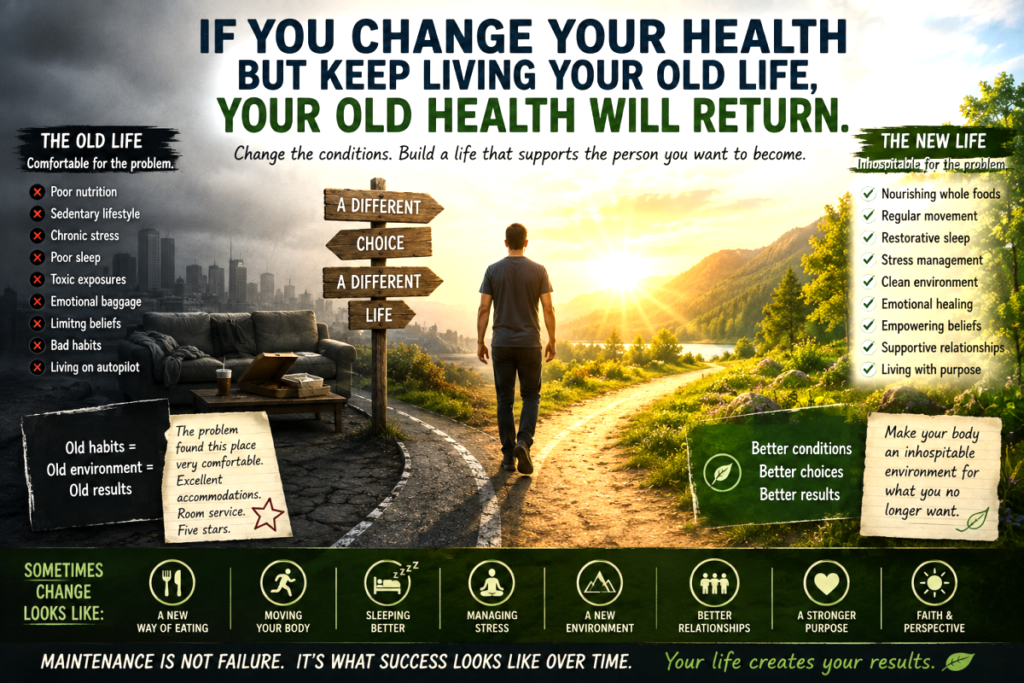
Here’s a metaphor I’ve used when talking about this. Imagine that a particular health problem has found your body to be a very comfortable place to live. Excellent accommodations. Everything it likes is already there.

Room service. Fresh towels. Turn-down service every night. Five stars.

Then you make changes. You alter the environment. Perhaps you improve metabolic health. Change nutrition. Become physically active. Correct a deficiency. Sleep differently. Reduce alcohol. Stop smoking. Lose excess body fat. Gain needed muscle. Address chronic stress. Follow an appropriate treatment or natural-health program.

Whatever combination applies to you, the environment begins changing.

The old problem may no longer find the accommodations quite so comfortable.

That’s useful. But here’s the part people sometimes miss:

If you rebuild the hotel exactly as it was before, don’t be surprised when the old guests check back in.

Make the Old Pattern Less Welcome

I sometimes describe this as making the body an inhospitable environment for the condition we’re trying to leave behind.

That isn’t a literal description of every disease process, of course. Diseases have different causes, and plenty of illnesses occur despite excellent lifestyles. But as a lifestyle principle, the metaphor is valuable.

If a condition is influenced by modifiable factors, change the factors you actually can.

Create better conditions. Better nutrition. Better metabolic health. Better sleep. Better movement. Better strength. Better recovery. Better stress management. Better relationships. Better environmental exposures where possible. Better medical care when needed. Better natural support when appropriate. Better decisions.

Not perfection. Better conditions.

Sometimes the Change Is Bigger Than Food and Exercise

This is where I’ve seen some extraordinary personal transformations. People sometimes assume a health journey means eating vegetables and joining a gym.

Sometimes it does. But sometimes the metamorphosis reaches much further.

Someone changes careers. Someone leaves an environment that has been crushing them. Someone moves to another part of the country. Someone discovers faith—or rediscovers it. Someone begins spending time outdoors. Someone ends a destructive relationship. Someone repairs an important relationship. Someone stops drinking. Someone learns to cook. Someone starts lifting weights at 60. Someone finally begins sleeping eight hours. Someone loses weight. Someone who has been undernourished gains needed weight and muscle.Someone stops making the same decisions they’ve made for thirty years.

Their entire life begins looking different. Why? Because somewhere along the way they stopped asking:

“How do I get rid of this problem?”

and started asking:

“What would my life look like if health actually mattered to me?”

That’s a much bigger question.

The Metamorphosis

I think metamorphosis is the right word. Because sustainable change can eventually affect identity.

  • At first, you’re forcing yourself to go for a walk. Later, you’re someone who walks.
  • At first, you’re forcing yourself to eat differently. Later, that’s simply how you eat.
  • At first, you’re trying desperately to remember your health regimen. Later, taking care of yourself is part of your ordinary day.
  • At first, you’re trying to become healthier. Eventually you begin thinking: I’m a person who takes care of my body.

That’s an enormous transition. Because willpower is exhausting.

Identity is different. Once the new behavior becomes part of who you are, you’re no longer negotiating every decision from scratch.

You Don’t Have to Become a Health Fanatic

This doesn’t mean your entire existence needs to revolve around wellness. You shouldn’t need seventeen alarms telling you when to swallow something for the rest of your life.

You don’t have to live at the gym. You don’t need to become afraid of restaurants. You don’t have to turn every meal into chemistry homework. And you certainly don’t need to become the person at every family gathering explaining what’s wrong with everybody else’s food.

The goal is not obsession. The goal is creating a life that naturally supports the person you’re becoming.

That’s very different.

Some Things Are Outside Our Control

There’s also an important humility required here. Lifestyle isn’t everything. Genetics matter. Age matters. Infections happen. Accidents happen. Environmental exposures matter.

Autoimmune diseases, cancers, neurological disorders, congenital conditions, and many other illnesses cannot simply be reduced to somebody’s lifestyle choices.

Healthy people get sick. People who do everything “right” can still develop serious disease. So this philosophy should never become a weapon for blaming sick people.

The useful question isn’t:

“What did you do to cause this?”

It’s:

“What can we influence from here?”

Sometimes the answer is a lot. Sometimes it’s very little. Either way, we work with what we have.

Maintenance Is Not Failure

This may be one of the biggest mindset changes of all. People sometimes believe that if something truly “worked,” they should eventually be able to stop doing everything that helped them and remain exactly the same. But why would that necessarily be true?

  • If exercise made you stronger, stopping exercise doesn’t prove exercise failed when you eventually become weaker.
  • If changing your diet improved a metabolic problem, returning permanently to the previous diet doesn’t prove the nutritional change was fraudulent if the problem returns.
  • If sleeping adequately improves how you function, going back to four hours a night doesn’t invalidate sleep.

Some improvements require maintenance because living organisms continuously respond to their environment.

Maintenance isn’t evidence of failure. Sometimes maintenance is simply what success looks like over time.

Don’t Just Change the Condition. Change the Conditions.

This is the lesson I keep coming back to. If something in your health needs to change, naturally you want to find the intervention.

The medicine. The supplement. The herb. The diet. The therapy. The protocol. The procedure. Whatever is appropriate.

But don’t stop your investigation there. Look around the intervention. Look at the life surrounding it.

  • What are you repeatedly giving your body?
  • What are you repeatedly asking it to endure?
  • What helped during the period when things improved?
  • What gradually disappeared?
  • What returned before the old problem returned?
  • What could become part of your life rather than merely part of your treatment?

Those questions may reveal something much larger than a protocol. They may reveal the next version of you. Because sometimes the greatest natural-health transformation isn’t discovering the perfect thing to take. It’s reaching the point where you genuinely want a different life badly enough to live differently.

And once that metamorphosis happens, you’re no longer waiting impatiently to finish your health program so you can get back to normal. You’re creating a new normal. A normal that supports where you’re going instead of continually rebuilding where you’ve been.

So remember:

If you change your health but keep returning to the life that helped sustain the old pattern, don’t be surprised when the old pattern returns.

Change the intervention when necessary. Change the protocol when necessary. But when your life itself is part of the equation—

change the conditions, too.


Categories
Blog

You Can’t Want Wellness for Someone More Than They Want It

Stop financing, convincing, and chasing the people you love. I’ve spent thousands of dollars buying natural-health products for people I love. I knew what I had experienced. I’d heard the stories. I’d seen enough over the years to become excited about possibilities that other people simply couldn’t see. So naturally, when someone I cared about was struggling, I wanted to help.


Here’s the painful part: More than once, I’ve had the opportunity after someone died to see some of those same products again. Unopened. Unused. Sometimes expired. Sitting there among their belongings at an estate sale, available for pennies on the dollar.

There is something profoundly sobering about seeing something you once purchased with so much hope sitting untouched after the person you hoped would use it is gone. Eventually, I had to learn something:

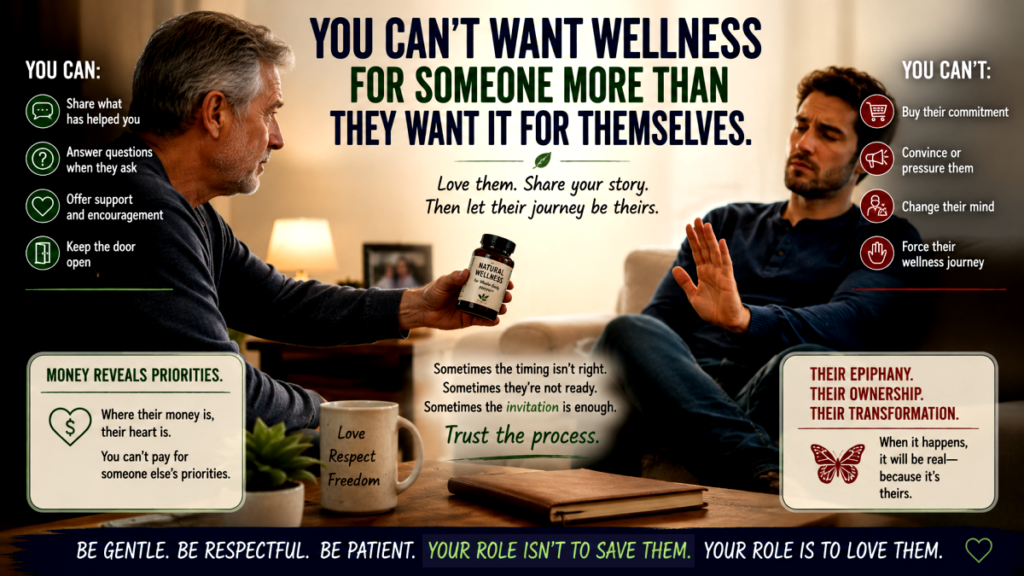
You cannot want wellness for someone more than they want it for themselves.

Love Makes Us Want to Rescue People

It’s understandable. Someone you love is hurting. You’ve discovered something that you believe has helped you or someone else.

Maybe you’ve experienced improvements personally. Maybe you’ve watched other people experience remarkable changes. Maybe you’ve spent years researching something they’ve never heard of.

From where you’re standing, it seems obvious. If they would just try this.

So you send them an article. Then a video. Then another article. You explain the science. You tell them somebody’s testimony. You buy them the product. You create a protocol.

You call three days later: “Have you started it yet?” No. A week later? Still no.

Now you’re frustrated. They’re irritated. And something that began as love has quietly become a campaign.

Stop.

Seriously. Stop. Not because you don’t love them. Because you do.

Their body belongs to them. Their health decisions belong to them. Their beliefs belong to them. Their timing belongs to them. And ultimately, their life belongs to them.

Natural wellness cannot be imposed upon another human being.

They May Not Hear What You Think You’re Saying

This can be particularly difficult for people who have spent years in natural and alternative health. You’ve accumulated an enormous amount of information. The person you’re talking to hasn’t.

You may think you’re saying:

“I love you. I’ve learned something that might help. Would you consider looking at this?”

But that isn’t necessarily what they’re hearing.

They may hear:

  • “You think you know more than my doctor.”
  • “You think I’m making stupid decisions.”
  • “You don’t respect my choices.”
  • “You’ve fallen for some weird health thing.”
  • “You’re trying to frighten me.”    Or simply:
  • “Oh no. Here we go again.”

And once somebody has placed you into their mental category of the kooky natural-health person, sending them another 47-minute video isn’t going to help. Neither will fourteen research papers. Neither will the testimonial from your friend’s cousin. Neither will another bottle appearing mysteriously on their doorstep.

Persuasion has a saturation point.

Beyond that point, more information frequently produces more resistance.

Don’t Fight Their Doctor Through Them

This is another trap. Maybe their physician strongly disagrees with the natural approach you’re discussing. Maybe the doctor has warned them against it.

You may believe the doctor’s assessment is mistaken. Fine. But now imagine the position of your loved one.

On one side is a credentialed medical professional they’ve trusted with their health. On the other side is you, telling them the doctor doesn’t understand this.

Now they’re not merely considering a supplement, dietary change, or alternative approach. They’re being asked to decide whom to trust. That’s an entirely different psychological problem. And the harder you push, the more threatening the decision can feel.

You don’t have to win that contest. In fact, refusing to compete may preserve the relationship.

Tell Your Story. Don’t Turn It Into Their Prescription.

There is nothing wrong with sharing your experience. Actually, I think personal stories are often the gentlest way to introduce someone to an unfamiliar idea.

  • “I started doing this because…”
  • “I noticed something interesting…”
  • “This helped me…”
  • “I’ve been researching…”
  • “I had an experience that surprised me…”

Then stop. Short. Sweet. Anecdotal. No conversion campaign attached. You’re planting information, not demanding agreement.

If they’re curious, they’ll ask another question. That’s your invitation. Answer that question. Not the next seventeen questions you wish they’d asked.

That’s an important discipline.

Someone asking one question about natural health does not necessarily mean:

“Please download your entire belief system into my brain.”

Meet their curiosity at the size at which it arrives.

Let Them Come Back

This is where things can get interesting. Six months later they may ask:

“What was that thing you mentioned?”

Now the conversation is different. Why? Because they initiated it.

Maybe something changed. Maybe their current approach isn’t giving them the results they wanted. Maybe they saw somebody else’s experience. Maybe they read something. Maybe they’ve simply become curious.

Whatever happened, a door opened from their side. Walk through gently. Don’t kick it off the hinges. Answer what they’re asking. Let them think. Let them investigate. Let them disagree. Let them leave and come back.

If natural wellness is going to become part of their life, it needs to become theirs, not yours.

And Please Stop Buying It for Them

This may be the hardest rule for natural-health enthusiasts who express love by helping.

Don’t buy the products for someone who isn’t already committed to using them.

I’ve learned this one the expensive way. It feels loving to remove the financial obstacle. Sometimes it is. But before spending your money, ask a revealing question:

Would they spend their own money on this?

If the answer is no, pay attention.

Money is one of the clearest indicators of priority we have. Look at almost anyone’s spending history and you’ll quickly discover what matters to them.

Housing. Food. Cars. Entertainment. Children. Pets. Travel. Hobbies. Coffee. Technology. Clothing. Convenience. Health.

Whatever receives someone’s resources is telling you something about what currently occupies space in their life.

That doesn’t mean somebody has to be wealthy to care about health. Nor does it mean people aren’t forced by circumstances to prioritize necessities over wellness products. But discretionary spending can reveal commitment.

If someone has the ability to invest in a wellness practice but consistently chooses not to, buying it for them rarely creates the missing commitment. It merely creates inventory. Sometimes very expensive inventory.

Ownership Changes Everything

There’s an enormous psychological difference between:

“David thinks I should take this.”

and:

“I’ve decided I want to do this.”

The first requires compliance. The second has ownership. And ownership matters enormously in natural wellness because, as we’ve already discussed, many natural approaches require persistence.

The person may need to remember something three times a day.

  • Change what they eat.
  • Track something.
  • Prepare something.
  • Research something.
  • Take something with food and something else away from food.
  • Continue for weeks or months before deciding whether meaningful change is occurring.

That’s difficult enough when someone desperately wants the outcome. Imagine trying to get them to do it when you want the outcome more than they do. You become their protocol police.

  • “Did you take it?”
  • “Did you do it?”
  • “Why didn’t you?”
  • “You said you would.”

That’s not wellness anymore. That’s relationship friction.

Wait for the Metamorphosis

Every once in a while, something happens. A person changes. Sometimes it’s a diagnosis. Sometimes it’s a birthday. Sometimes it’s watching someone else decline. Sometimes they’re simply tired of feeling the way they’ve been feeling. Sometimes they encounter an idea at exactly the right moment. Whatever triggers it, their relationship with their health changes.

Suddenly they’re researching. Reading labels. Asking questions. Changing their diet. Buying things themselves. Tracking results. Getting appropriate testing. Taking responsibility. Doing things you couldn’t have persuaded them to do six months earlier.

It’s almost a metamorphosis. And those of us who love people desperately want to cause that transformation for them. But we can’t.

The realization has to become their realization.

Your Job Is Smaller Than You Think

You don’t have to save everybody. You don’t have to convert anybody. You don’t have to win the argument between conventional and alternative medicine at Thanksgiving dinner. You don’t need to leave supplements anonymously on people’s porches.

You can simply live. Take care of yourself. Learn. Experiment responsibly. Pay attention. Become healthier if you can.

Share what you’ve experienced when it’s appropriate. And when someone becomes genuinely curious, be generous with what you’ve learned. But leave their autonomy intact.

There is something deeply respectful about being able to say:

“This has been meaningful for me. If you ever want to know more, I’m happy to share what I’ve learned.”

And then actually leaving it there. No pressure. No judgment. No disappointment. No sales pitch. Just an open door. Because when someone finally walks through that door on their own, you have something you never could have purchased for them.

Their participation.

And without that, even the most promising bottle in the world may do nothing more than sit unopened on a shelf.

  • You cannot force someone into a natural-wellness lifestyle.
  • You cannot purchase commitment for them.
  • You cannot manufacture their epiphany.
  • You can love them.
  • You can respect them.
  • You can answer when they ask.
  • And you can let their journey belong to them.

You can’t want wellness for someone more than they want it for themselves.


Categories
Blog

Natural Alternatives Are Not Instantaneous — Healing Takes Time

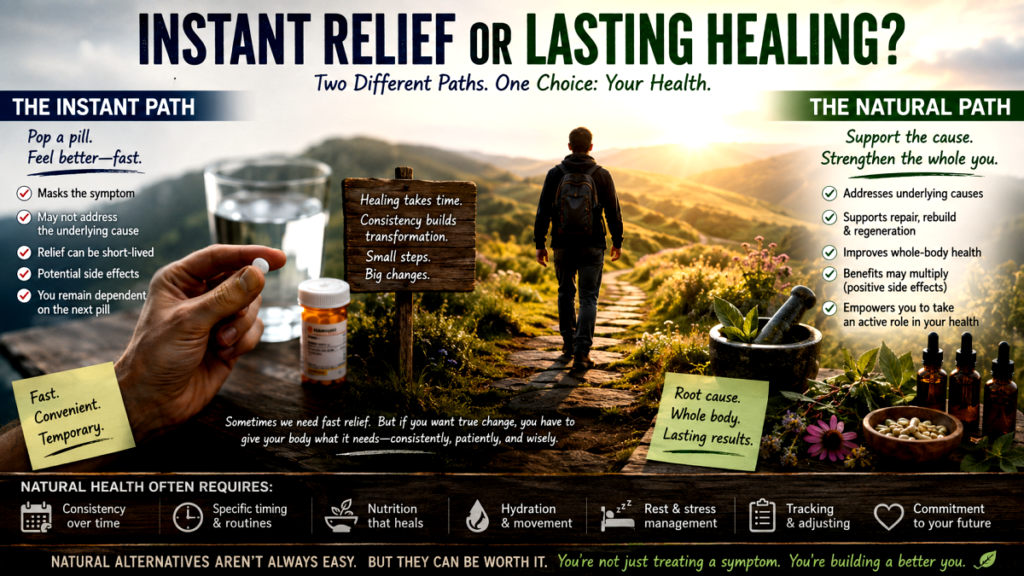
We have become accustomed to fast relief. Headache? Take something. Heartburn? Take something. Can’t sleep? Take something. Something hurts? Take something. And when the right medication is used for the right problem, sometimes the relief is astonishingly fast.

That’s wonderful when relief is what we need. But it also creates an expectation:

If something is working, shouldn’t I feel it right away?

That expectation can become one of the greatest obstacles people encounter when they begin exploring natural alternatives. Because natural approaches frequently aren’t trying to accomplish the same thing.

Relief and Repair Operate on Different Timelines

Imagine you’ve been living in a house for 30 years. One afternoon, you notice an ugly water stain spreading across the ceiling. You could paint over it. Twenty minutes later, you wouldn’t see the stain anymore.

Problem solved? Not exactly.

Someone interested in the underlying problem starts asking questions.

  • Where is the water coming from?
  • Is there a leaking pipe?
  • A roofing problem?
  • How long has it been leaking?
  • Is the insulation wet?
  • Has mold developed?
  • Has the wood begun deteriorating?

Suddenly, what looked like a twenty-minute paint job has become an investigation. And fixing the underlying problem takes longer.

That’s because covering evidence of a problem and repairing the conditions producing it are two different jobs.

This is one way to understand the patience sometimes required in natural health.

The Body Needs Time

The human body is constantly rebuilding itself. Cells are repaired and replaced. Tissues remodel. Hormones respond to changing conditions. Nutritional reserves can be depleted and replenished. Muscles strengthen with repeated use. Metabolic health can change. Sleep patterns can improve. The nervous system adapts.

None of this happens because we snapped our fingers. Biology operates on biological time.

If you’ve spent years creating—or simply living with—the conditions associated with poor health, it may be unrealistic to expect those conditions to change completely by Tuesday.

That’s frustrating. But it also makes sense.

Sometimes a Natural Protocol Is Inconvenient

This is another part we probably don’t talk about enough. A serious natural-health regimen can be a nuisance. Your personal program might involve one supplement with breakfast and dinner. Something else three times a day. Another intervention at bedtime.

Certain things with food. Others away from food. Perhaps dietary changes. More water. Movement. Sunlight. Better sleep habits. Tracking how you respond. And depending upon the particular approach being followed, there may be interventions performed at particular intervals throughout the day.

That is considerably more complicated than:

Take one tablet once a day.

No wonder people sometimes lose interest.

Natural-health enthusiasts occasionally talk as though everybody should naturally be excited about doing all this. They’re not. People have jobs. Children. Appointments. Bills. Responsibilities. They forget things. They’re tired.

Convenience matters. That’s one of the enormous advantages of modern pharmaceutical medicine: it has become extraordinarily good at making many interventions simple.

Natural approaches often ask considerably more participation from the individual.

“How Long Do I Have to Do This?”

This is one of the questions I’ve heard again and again:

“How long do I have to keep doing this?”

I’ve always found the wording fascinating. There’s something hidden inside it.

When will my sentence be over?

When can I stop doing this annoying thing and return to normal?

And certainly, some protocols are temporary. Some supplements or interventions should only be used for a particular period, and some can become inappropriate or harmful when continued indefinitely. But other health practices raise a different question.

If something is safe for you, sustainable, and genuinely improving your quality of life, why is stopping automatically the goal?

Nobody asks:

“How long do I have to keep drinking water?”

“How many more months do I have to sleep?”

“When can I finally stop eating nutritious food?”

“When will I have exercised enough that I never need to move again?”

We understand intuitively that certain things aren’t treatments. They’re part of caring for a human body.

Maybe We Need a Better Question

Instead of:

“How long do I have to do this?”

perhaps ask:

“What is this doing for me?”

    • Is my energy improving?
    • Am I sleeping better?
    • Is my mobility changing?
    • How is my digestion?
    • What are my objective health markers doing?
    • Am I stronger?
    • Do I recover more easily?
    • Has my quality of life improved?
    • Are there adverse effects?
    • Is this still necessary?
    • Could the regimen now be simplified?

Those questions turn obedience into participation. You’re no longer serving the protocol.

The protocol is supposed to be serving you.

That’s an important distinction.

Persistence Doesn’t Mean Blind Persistence

There is another side to this.

Natural-health people can become so committed to the idea that “healing takes time” that they continue something indefinitely even when it isn’t helping. That’s not persistence. That’s attachment.

If an approach isn’t producing the expected changes, investigate.

  • Maybe the dose or timing is wrong.
  • Maybe the original assumption was wrong.
  • Maybe you’re missing another piece.
  • Maybe the product isn’t what you thought it was.
  • Maybe the condition requires testing.
  • Maybe something else entirely is happening.

And sometimes the appropriate next stop really is a physician. Patience should never become an excuse for ignoring deterioration.

Give the body time—but keep paying attention to the body.

The People Who Stay With It Understand the Trade

People who become enthusiastic about natural alternatives often eventually understand something that beginners don’t.

They’re no longer looking only for the fastest way to stop feeling something. They’re investing in the condition of the body itself.

  • Nutrition.
  • Strength.
  • Sleep.
  • Movement.
  • Metabolic health.
  • Stress regulation.
  • Healthy aging.
  • Resilience.
  • Recovery.

Those things are built through repetition. And repetition requires persistence. The payoff isn’t necessarily a dramatic sensation ten minutes after swallowing something.

Sometimes the first evidence is almost disappointingly ordinary.

  • You sleep through the night.
  • You realize you haven’t had that afternoon crash lately.
  • The stairs seem easier.
  • You’re thinking more clearly.
  • You wake up before the alarm.
  • Something that used to bother you every morning hasn’t bothered you for three weeks.

Then one day you realize:

I feel better than I used to.

We May Be Asking the Wrong Thing of Our Bodies

We live in an instantaneous culture. Instant messages. Instant purchases. Instant entertainment. Instant answers. So naturally, we want instant health. But the body isn’t an app.

  • It is alive.
  • It adapts.
  • It repairs.
  • It responds.
  • It changes according to what we repeatedly give it and repeatedly ask of it.

Sometimes immediate relief is exactly what we need. But when we’re trying to improve the underlying conditions associated with health, the better question may not be:

“How fast can I make this feeling disappear?”

It may be:

“What can I consistently do that gives my body better conditions in which to function?”

Then do that.

  • Pay attention.
  • Adjust when necessary.
  • Measure what can be measured.
  • Keep what genuinely helps.
  • Discard what doesn’t.

And give biology something our instantaneous world doesn’t particularly like giving anything anymore:

Time.


Categories
Blog

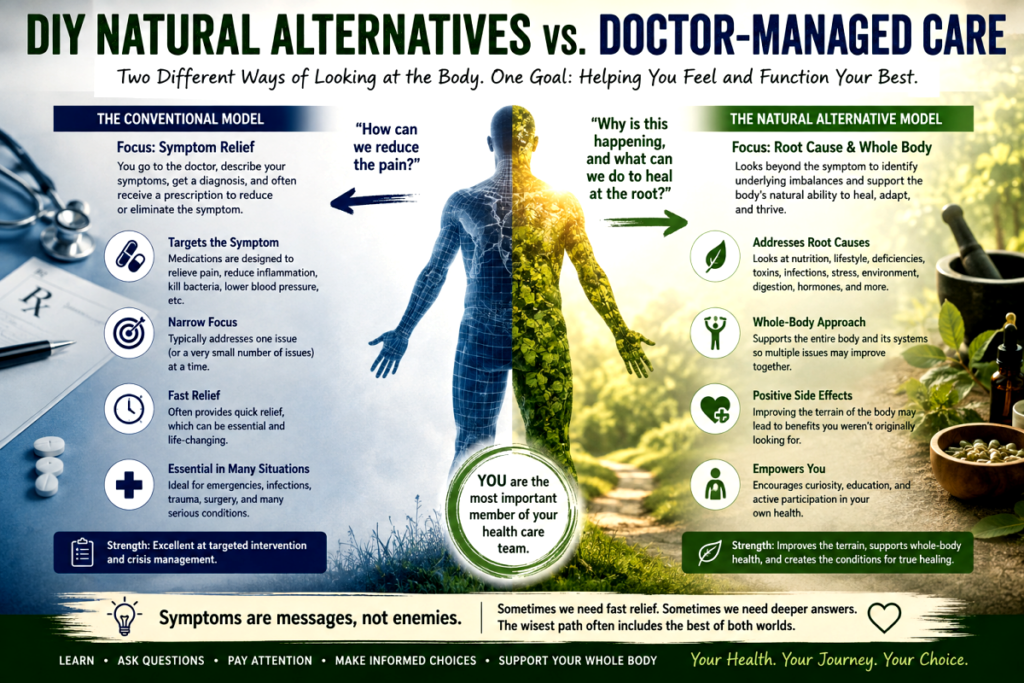
DIY Natural Alternatives vs. Doctor-Managed Care: What’s the Difference?

“Doctor, it hurts when I do this.” For most of us, that’s a perfectly reasonable reason to make an appointment. Something hurts. Something isn’t working correctly. We can’t sleep. Our stomach is upset. Our joints ache. We’re exhausted. We have a rash, headache, infection, inflammation, or some other complaint that is interfering with life. We want it fixed. And modern medicine can be remarkably good at this.

You walk into an office with a problem. The physician evaluates you, perhaps orders tests, reaches a diagnosis, and may prescribe something intended to relieve the symptom or treat the diagnosed condition. Sometimes that is exactly what we need. But the natural-alternative mindset often begins with another question:

Why is this happening?

That one question can send us down an entirely different road.

Symptom Relief and Root-Cause Thinking

Suppose your hip hurts. There are several perfectly legitimate ways to approach that complaint. One approach asks:

How can we reduce the pain?

Another asks:

What is producing the pain?

And a more expansive natural-health approach may ask:

What is happening throughout this person’s body that might be contributing to the conditions in which this pain developed?

Those aren’t necessarily competing questions. The problem comes when we answer only the first one.

Pain relief can be tremendously valuable. Nobody gets extra points for suffering unnecessarily. But removing the sensation of pain isn’t necessarily the same thing as changing whatever produced the pain.

That distinction is fundamental to understanding the DIY natural-alternative approach.

The Body Isn’t a Collection of Independent Parts

One of the most attractive ideas in natural health is remarkably simple:

Everything is connected.

Your hip isn’t living an independent life. Neither is your digestive tract. Neither is your immune system, circulatory system, nervous system, endocrine system, liver, kidneys, brain, muscles, or microbiome. They’re participating in the same biological environment.

This is why the natural-alternative investigator frequently becomes interested in things that initially seem unrelated to the presenting complaint.

    • What are you eating?
    • How are you sleeping?
    • How much are you moving?
    • How well are you hydrated?
    • What’s happening with digestion?
    • What nutrients might be missing?
    • What medications and supplements are you taking?
    • What environmental exposures are present?
    • What’s happening with stress?
    • What changed before the problem began?

Instead of asking only, “What can make this symptom stop?” we begin looking at the person who is experiencing the symptom. That is a very different investigation.

Becoming the Investigator of Your Own Body

This is where DIY natural health becomes fascinating. You start researching one problem and discover an entire world you didn’t know existed. Maybe you begin because your knees hurt. Then you learn about inflammation. That leads you to nutrition. Nutrition leads you to blood sugar. Blood sugar leads you to sleep. Sleep leads you to hormones. Hormones lead you to stress. Stress leads you to the nervous system.

Before long, the person who originally wanted nothing more than to make a knee stop hurting has begun examining how they live.

That doesn’t mean every theory they encounter will be correct. It doesn’t mean every supplement works. And it certainly doesn’t mean every health problem can be solved at home.

It means something much simpler:

Curiosity has replaced passivity.

You have become a participant in your own health.

The Curious Case of “Positive Side Effects”

Here’s something I’ve heard repeatedly over years of conversations with people involved in natural and alternative health.

Someone changes something because of one complaint. But something else improves. Then something else.

Maybe someone begins a nutritional program because they’re concerned about joint discomfort and later reports that they’re sleeping better.

Someone changes their diet for digestive reasons and notices that their afternoon fatigue disappears.

Another person addresses nutritional deficiencies and reports improved energy, mood, or exercise tolerance.

Sometimes people describe surprisingly dramatic changes in problems they weren’t originally trying to address. I think of these as positive side effects.

That phrase makes people smile because we’re accustomed to hearing the opposite.

We see advertisements for medications followed by long lists of possible adverse effects. But when someone improves the nutritional or physiological environment of the body, it isn’t particularly surprising that the effects may be experienced in more than one place.

That doesn’t prove that every improvement was caused by the intervention. Human biology is complicated, and personal reports aren’t controlled clinical trials. But the phenomenon is interesting enough to pay attention to. Especially when you’re the person experiencing it.

Targeted Intervention vs. Improving the Terrain

Pharmaceutical medicine frequently excels at targeted intervention. That’s one of its strengths. If a specific organism is causing an infection, for example, an appropriate antimicrobial drug may be selected because of its activity against that organism.

If blood pressure is dangerously high, medication may lower it. If inflammation is causing serious damage, controlling that inflammation can be enormously important.

Natural-health approaches often think somewhat differently.

Rather than targeting only one biochemical pathway, organism, or symptom, many natural approaches attempt to improve what practitioners sometimes call the body’s terrain—the overall physiological environment in which health or disease is occurring.

That might involve nutrition, micronutrients, sleep, movement, hydration, metabolic health, digestive function, stress regulation, or particular herbs and natural substances. And because those things aren’t confined to one body part, improving them may influence several systems simultaneously.

This is one reason people sometimes report benefits they weren’t looking for.

Natural Doesn’t Automatically Mean Safe

There is an important responsibility that comes with becoming your own investigator. “Natural” isn’t synonymous with “harmless.” Nature contains extraordinarily powerful chemistry.

Herbs can interact with medications. Nutrients can be taken in excessive amounts. Natural substances can be inappropriate for certain medical conditions. And symptoms that appear minor can occasionally be warning signs of something requiring immediate medical attention.

So DIY natural health shouldn’t mean:

I don’t need doctors anymore.

A much more useful philosophy is:

I want to become an informed participant in my health instead of outsourcing every decision about my body.

Those are very different positions.

Doctors and Natural Alternatives Don’t Have to Be Enemies

This may be particularly important today. There are people in the natural-health community who distrust conventional medicine profoundly.

Some have reasons rooted in difficult personal experiences. Others object to pharmaceutical influence, short appointment times, fragmented specialties, or a healthcare system that can sometimes feel better designed for managing disease than cultivating health.

Those concerns deserve discussion. But we don’t have to turn doctors into villains to recognize limitations in the system.

I’ve met wonderful physicians. I’ve also encountered natural-health practitioners whose confidence greatly exceeded their knowledge. Neither white coats nor herbs confer infallibility.

The useful question isn’t:

Which team are you on?

It’s:

What does this person need?

Sometimes the answer may be emergency medicine. Sometimes surgery. Sometimes antibiotics or another prescription. Sometimes nutrition. Sometimes movement. Sometimes rest. Sometimes correcting a deficiency. Sometimes an herb or another natural intervention. And sometimes the wisest answer is a combination.

Don’t Just Silence the Messenger

Symptoms are unpleasant. Naturally, we want them gone. But sometimes a symptom is also information.

Pain says something. Fatigue says something. Digestive trouble says something. Insomnia says something. Recurring headaches say something.

The message may be simple or complicated. It may have one cause or several. And sometimes extensive investigation still doesn’t reveal a satisfying explanation. But there is value in remaining curious.

Instead of asking only:

“What can I take to make this stop?”

we can also ask:

“Why might my body be doing this?”

And then:

“What does my body need in order to function better?”

That shift—from fighting the symptom to becoming curious about the person experiencing it—is one of the most valuable contributions of the natural-health philosophy.

It doesn’t require abandoning medicine. It doesn’t require believing every alternative claim. And it doesn’t require handing your judgment over to another authority, conventional or alternative.

It simply means becoming more engaged.

  • Learn.
  • Ask questions.
  • Pay attention to patterns.
  • Notice what changes.
  • Keep good records.
  • Use appropriate testing when it’s useful.
  • Seek qualified help when you need it.

And perhaps most importantly:

Don’t become so focused on making one symptom disappear that you forget the extraordinary biological system that’s trying to communicate with you.

The goal isn’t merely to feel less sick.

Whenever possible, the greater goal is to help the whole person become healthier.


Categories
Blog

Natural Alternative Specialist

Did you know that the earth was made to sustain all forms of life? To be able to keep us all fed for years and years to come? Did you also know that each plant is either good for  food to nourish our bodies or it is good for healing our bodies too? We just have to find that out all over again. What each of the plants can do to heal and nurture the human body.

When God made the earth, he made it to keep us well fed. Everything he has put on this planet is to help us to stay healthy and very much alive, from the smallest plant to the biggest tree there is some kind of healing benefit. It may take a little longer but we do feel better with time.

With today’s technology we may be able to find out more about how these plants can help us feel better naturally, but with the big pharma companies that are making millions, they don’t want you to get healthy.

So they make pills to make you think you are getting better, but it is only creating more problems than it is helping!

What is even more sad than that, is the greed of these companies for money. They don’t care about the life they are ruining, but there are many plants out there that can heal many illness today. Sadly, we are not told of this by todays doctors!

If you tell them that you are trying a natural remedy they tell you its not going to work. Then they try to persuade you to change your mind.

In today’s times much has changed. Our food is not as healthy as it once was. There are so many chemicals going into our food in these modern times that it is effecting our bodies more and more each day.

Not only our bodies, but that of our animals too. We have gotten so out of control with everything we touch, thinking we are making improvements, that we don’t see what is happening or refuse to see it and don’t care what happens.

Now we are at a point of no return! Or are we?

We can make this change that we desperately need to have a better world for the next generation! It needs to start now.

Our planet earth that we live on has always been able to heal itself in many ways. It has its storms, heat waves, winds, and floods. But it has always managed to redeem itself and continue to do what it does best. And that is to heal itself and continue to provide us with everything that growers on it.

But we have not helped much to keep it going.  By cutting of the rainforest and other essential plants we are shooting ourselves in the foot!

With our growing population, we have been trying to grow everything much faster. Even the poor animals are being effected, giving them chemicals to grow faster and fatter, but not knowing or caring what we  eat is effecting us too. Because we also eat these same animals that are being given these chemicals!

We are what we eat, as it is said, and those are very true words!

“Bon appétit.”