Categories
Blog

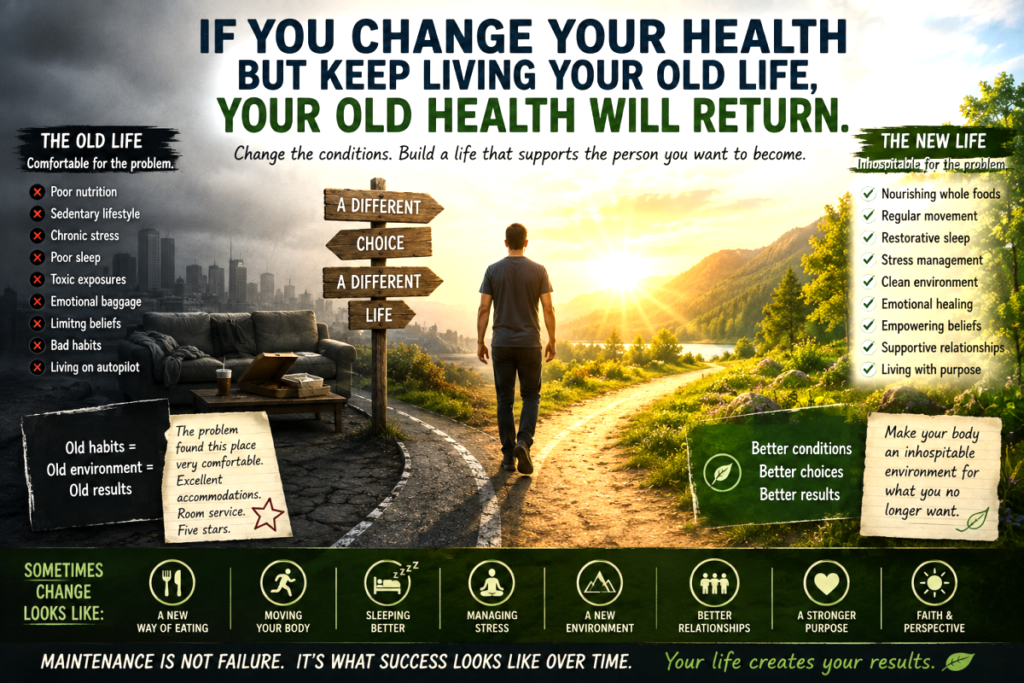
Change Your Health by Changing the Life That Supports It

Healing isn’t just something you do. Sometimes it becomes a different way of living. Something interesting happens when you spend enough time around people who have dramatically changed their health. Eventually you notice that the most remarkable transformations frequently aren’t about what someone took. They’re about what someone became.
The person may have started with a supplement. A dietary change.An exercise program. A natural-health protocol. A frightening diagnosis. A book. A conversation. A moment when they looked in the mirror and realized:

I cannot keep living like this.

Whatever started it, somewhere along the way the project became bigger than the original complaint. Their life began changing. And that, I believe, is where things get really interesting.

We Want Different Results Without a Different Life

Human beings have an understandable tendency. We want the problem removed. But we’d really rather keep everything else.

Fix my blood sugar, but don’t touch my diet.

  • Help my cardiovascular health, but don’t make me move.
  • Give me energy, but don’t interfere with my sleep schedule.
  • Help my digestion, but let me continue eating whatever I want.
  • Lower my stress, but don’t ask me to reconsider the environment producing it.
  • Help my body—but please leave my life alone.

Sometimes we can get away with that. Sometimes we can’t. Because the body we’re trying to change is living inside the life we’re refusing to change.

“See? I Knew It Wouldn’t Work.”

I’ve watched variations of this happen. Someone has a significant health problem. They get serious. Maybe they change their diet dramatically. Lose weight. Exercise. Follow a natural-health regimen. Work closely with a healthcare professional.

Their numbers improve. Their symptoms improve. In some cases, a condition such as type 2 diabetes may even go into remission.

They’re thrilled. Then something happens. They begin drifting.

A little of the old diet comes back. Then more. Exercise disappears. Sleep deteriorates. Weight returns. The protocol gets abandoned. The new habits gradually become old memories.

Months later, their health markers begin moving in the wrong direction again. And then comes the declaration:

“See? I knew it wouldn’t work.”

Wait a minute. Maybe it did work. Maybe that’s precisely what the period of improvement demonstrated.

The more useful question might be:

What changed when your health improved—and what changed again before the problem returned?

That’s a much more interesting investigation.

Your Body Is an Environment

Here’s a metaphor I’ve used when talking about this. Imagine that a particular health problem has found your body to be a very comfortable place to live. Excellent accommodations. Everything it likes is already there.

Room service. Fresh towels. Turn-down service every night. Five stars.

Then you make changes. You alter the environment. Perhaps you improve metabolic health. Change nutrition. Become physically active. Correct a deficiency. Sleep differently. Reduce alcohol. Stop smoking. Lose excess body fat. Gain needed muscle. Address chronic stress. Follow an appropriate treatment or natural-health program.

Whatever combination applies to you, the environment begins changing.

The old problem may no longer find the accommodations quite so comfortable.

That’s useful. But here’s the part people sometimes miss:

If you rebuild the hotel exactly as it was before, don’t be surprised when the old guests check back in.

Make the Old Pattern Less Welcome

I sometimes describe this as making the body an inhospitable environment for the condition we’re trying to leave behind.

That isn’t a literal description of every disease process, of course. Diseases have different causes, and plenty of illnesses occur despite excellent lifestyles. But as a lifestyle principle, the metaphor is valuable.

If a condition is influenced by modifiable factors, change the factors you actually can.

Create better conditions. Better nutrition. Better metabolic health. Better sleep. Better movement. Better strength. Better recovery. Better stress management. Better relationships. Better environmental exposures where possible. Better medical care when needed. Better natural support when appropriate. Better decisions.

Not perfection. Better conditions.

Sometimes the Change Is Bigger Than Food and Exercise

This is where I’ve seen some extraordinary personal transformations. People sometimes assume a health journey means eating vegetables and joining a gym.

Sometimes it does. But sometimes the metamorphosis reaches much further.

Someone changes careers. Someone leaves an environment that has been crushing them. Someone moves to another part of the country. Someone discovers faith—or rediscovers it. Someone begins spending time outdoors. Someone ends a destructive relationship. Someone repairs an important relationship. Someone stops drinking. Someone learns to cook. Someone starts lifting weights at 60. Someone finally begins sleeping eight hours. Someone loses weight. Someone who has been undernourished gains needed weight and muscle.Someone stops making the same decisions they’ve made for thirty years.

Their entire life begins looking different. Why? Because somewhere along the way they stopped asking:

“How do I get rid of this problem?”

and started asking:

“What would my life look like if health actually mattered to me?”

That’s a much bigger question.

The Metamorphosis

I think metamorphosis is the right word. Because sustainable change can eventually affect identity.

  • At first, you’re forcing yourself to go for a walk. Later, you’re someone who walks.
  • At first, you’re forcing yourself to eat differently. Later, that’s simply how you eat.
  • At first, you’re trying desperately to remember your health regimen. Later, taking care of yourself is part of your ordinary day.
  • At first, you’re trying to become healthier. Eventually you begin thinking: I’m a person who takes care of my body.

That’s an enormous transition. Because willpower is exhausting.

Identity is different. Once the new behavior becomes part of who you are, you’re no longer negotiating every decision from scratch.

You Don’t Have to Become a Health Fanatic

This doesn’t mean your entire existence needs to revolve around wellness. You shouldn’t need seventeen alarms telling you when to swallow something for the rest of your life.

You don’t have to live at the gym. You don’t need to become afraid of restaurants. You don’t have to turn every meal into chemistry homework. And you certainly don’t need to become the person at every family gathering explaining what’s wrong with everybody else’s food.

The goal is not obsession. The goal is creating a life that naturally supports the person you’re becoming.

That’s very different.

Some Things Are Outside Our Control

There’s also an important humility required here. Lifestyle isn’t everything. Genetics matter. Age matters. Infections happen. Accidents happen. Environmental exposures matter.

Autoimmune diseases, cancers, neurological disorders, congenital conditions, and many other illnesses cannot simply be reduced to somebody’s lifestyle choices.

Healthy people get sick. People who do everything “right” can still develop serious disease. So this philosophy should never become a weapon for blaming sick people.

The useful question isn’t:

“What did you do to cause this?”

It’s:

“What can we influence from here?”

Sometimes the answer is a lot. Sometimes it’s very little. Either way, we work with what we have.

Maintenance Is Not Failure

This may be one of the biggest mindset changes of all. People sometimes believe that if something truly “worked,” they should eventually be able to stop doing everything that helped them and remain exactly the same. But why would that necessarily be true?

  • If exercise made you stronger, stopping exercise doesn’t prove exercise failed when you eventually become weaker.
  • If changing your diet improved a metabolic problem, returning permanently to the previous diet doesn’t prove the nutritional change was fraudulent if the problem returns.
  • If sleeping adequately improves how you function, going back to four hours a night doesn’t invalidate sleep.

Some improvements require maintenance because living organisms continuously respond to their environment.

Maintenance isn’t evidence of failure. Sometimes maintenance is simply what success looks like over time.

Don’t Just Change the Condition. Change the Conditions.

This is the lesson I keep coming back to. If something in your health needs to change, naturally you want to find the intervention.

The medicine. The supplement. The herb. The diet. The therapy. The protocol. The procedure. Whatever is appropriate.

But don’t stop your investigation there. Look around the intervention. Look at the life surrounding it.

  • What are you repeatedly giving your body?
  • What are you repeatedly asking it to endure?
  • What helped during the period when things improved?
  • What gradually disappeared?
  • What returned before the old problem returned?
  • What could become part of your life rather than merely part of your treatment?

Those questions may reveal something much larger than a protocol. They may reveal the next version of you. Because sometimes the greatest natural-health transformation isn’t discovering the perfect thing to take. It’s reaching the point where you genuinely want a different life badly enough to live differently.

And once that metamorphosis happens, you’re no longer waiting impatiently to finish your health program so you can get back to normal. You’re creating a new normal. A normal that supports where you’re going instead of continually rebuilding where you’ve been.

So remember:

If you change your health but keep returning to the life that helped sustain the old pattern, don’t be surprised when the old pattern returns.

Change the intervention when necessary. Change the protocol when necessary. But when your life itself is part of the equation—

change the conditions, too.


Categories
Blog

You Can’t Want Wellness for Someone More Than They Want It

Stop financing, convincing, and chasing the people you love. I’ve spent thousands of dollars buying natural-health products for people I love. I knew what I had experienced. I’d heard the stories. I’d seen enough over the years to become excited about possibilities that other people simply couldn’t see. So naturally, when someone I cared about was struggling, I wanted to help.


Here’s the painful part: More than once, I’ve had the opportunity after someone died to see some of those same products again. Unopened. Unused. Sometimes expired. Sitting there among their belongings at an estate sale, available for pennies on the dollar.

There is something profoundly sobering about seeing something you once purchased with so much hope sitting untouched after the person you hoped would use it is gone. Eventually, I had to learn something:

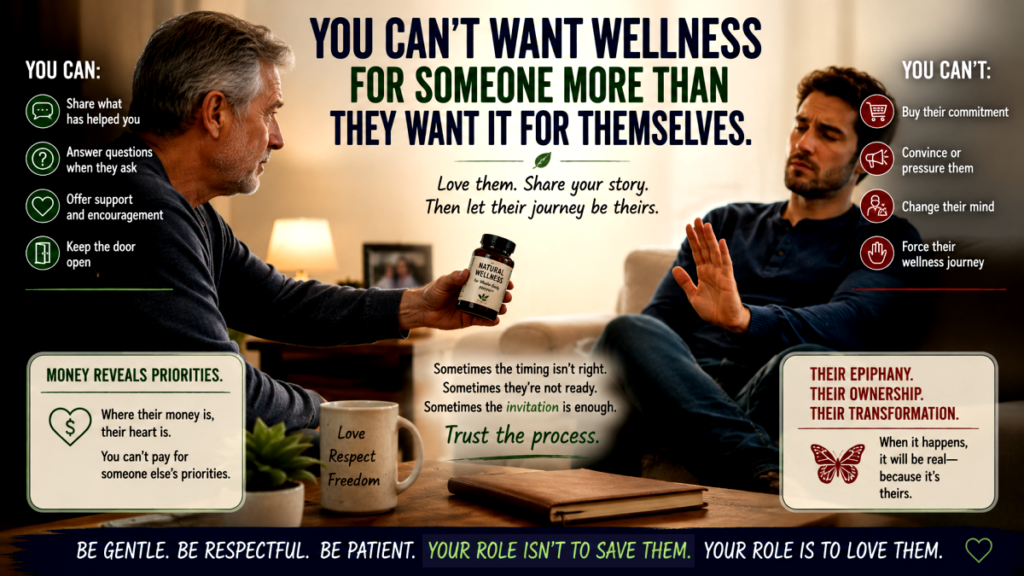
You cannot want wellness for someone more than they want it for themselves.

Love Makes Us Want to Rescue People

It’s understandable. Someone you love is hurting. You’ve discovered something that you believe has helped you or someone else.

Maybe you’ve experienced improvements personally. Maybe you’ve watched other people experience remarkable changes. Maybe you’ve spent years researching something they’ve never heard of.

From where you’re standing, it seems obvious. If they would just try this.

So you send them an article. Then a video. Then another article. You explain the science. You tell them somebody’s testimony. You buy them the product. You create a protocol.

You call three days later: “Have you started it yet?” No. A week later? Still no.

Now you’re frustrated. They’re irritated. And something that began as love has quietly become a campaign.

Stop.

Seriously. Stop. Not because you don’t love them. Because you do.

Their body belongs to them. Their health decisions belong to them. Their beliefs belong to them. Their timing belongs to them. And ultimately, their life belongs to them.

Natural wellness cannot be imposed upon another human being.

They May Not Hear What You Think You’re Saying

This can be particularly difficult for people who have spent years in natural and alternative health. You’ve accumulated an enormous amount of information. The person you’re talking to hasn’t.

You may think you’re saying:

“I love you. I’ve learned something that might help. Would you consider looking at this?”

But that isn’t necessarily what they’re hearing.

They may hear:

  • “You think you know more than my doctor.”
  • “You think I’m making stupid decisions.”
  • “You don’t respect my choices.”
  • “You’ve fallen for some weird health thing.”
  • “You’re trying to frighten me.”    Or simply:
  • “Oh no. Here we go again.”

And once somebody has placed you into their mental category of the kooky natural-health person, sending them another 47-minute video isn’t going to help. Neither will fourteen research papers. Neither will the testimonial from your friend’s cousin. Neither will another bottle appearing mysteriously on their doorstep.

Persuasion has a saturation point.

Beyond that point, more information frequently produces more resistance.

Don’t Fight Their Doctor Through Them

This is another trap. Maybe their physician strongly disagrees with the natural approach you’re discussing. Maybe the doctor has warned them against it.

You may believe the doctor’s assessment is mistaken. Fine. But now imagine the position of your loved one.

On one side is a credentialed medical professional they’ve trusted with their health. On the other side is you, telling them the doctor doesn’t understand this.

Now they’re not merely considering a supplement, dietary change, or alternative approach. They’re being asked to decide whom to trust. That’s an entirely different psychological problem. And the harder you push, the more threatening the decision can feel.

You don’t have to win that contest. In fact, refusing to compete may preserve the relationship.

Tell Your Story. Don’t Turn It Into Their Prescription.

There is nothing wrong with sharing your experience. Actually, I think personal stories are often the gentlest way to introduce someone to an unfamiliar idea.

  • “I started doing this because…”
  • “I noticed something interesting…”
  • “This helped me…”
  • “I’ve been researching…”
  • “I had an experience that surprised me…”

Then stop. Short. Sweet. Anecdotal. No conversion campaign attached. You’re planting information, not demanding agreement.

If they’re curious, they’ll ask another question. That’s your invitation. Answer that question. Not the next seventeen questions you wish they’d asked.

That’s an important discipline.

Someone asking one question about natural health does not necessarily mean:

“Please download your entire belief system into my brain.”

Meet their curiosity at the size at which it arrives.

Let Them Come Back

This is where things can get interesting. Six months later they may ask:

“What was that thing you mentioned?”

Now the conversation is different. Why? Because they initiated it.

Maybe something changed. Maybe their current approach isn’t giving them the results they wanted. Maybe they saw somebody else’s experience. Maybe they read something. Maybe they’ve simply become curious.

Whatever happened, a door opened from their side. Walk through gently. Don’t kick it off the hinges. Answer what they’re asking. Let them think. Let them investigate. Let them disagree. Let them leave and come back.

If natural wellness is going to become part of their life, it needs to become theirs, not yours.

And Please Stop Buying It for Them

This may be the hardest rule for natural-health enthusiasts who express love by helping.

Don’t buy the products for someone who isn’t already committed to using them.

I’ve learned this one the expensive way. It feels loving to remove the financial obstacle. Sometimes it is. But before spending your money, ask a revealing question:

Would they spend their own money on this?

If the answer is no, pay attention.

Money is one of the clearest indicators of priority we have. Look at almost anyone’s spending history and you’ll quickly discover what matters to them.

Housing. Food. Cars. Entertainment. Children. Pets. Travel. Hobbies. Coffee. Technology. Clothing. Convenience. Health.

Whatever receives someone’s resources is telling you something about what currently occupies space in their life.

That doesn’t mean somebody has to be wealthy to care about health. Nor does it mean people aren’t forced by circumstances to prioritize necessities over wellness products. But discretionary spending can reveal commitment.

If someone has the ability to invest in a wellness practice but consistently chooses not to, buying it for them rarely creates the missing commitment. It merely creates inventory. Sometimes very expensive inventory.

Ownership Changes Everything

There’s an enormous psychological difference between:

“David thinks I should take this.”

and:

“I’ve decided I want to do this.”

The first requires compliance. The second has ownership. And ownership matters enormously in natural wellness because, as we’ve already discussed, many natural approaches require persistence.

The person may need to remember something three times a day.

  • Change what they eat.
  • Track something.
  • Prepare something.
  • Research something.
  • Take something with food and something else away from food.
  • Continue for weeks or months before deciding whether meaningful change is occurring.

That’s difficult enough when someone desperately wants the outcome. Imagine trying to get them to do it when you want the outcome more than they do. You become their protocol police.

  • “Did you take it?”
  • “Did you do it?”
  • “Why didn’t you?”
  • “You said you would.”

That’s not wellness anymore. That’s relationship friction.

Wait for the Metamorphosis

Every once in a while, something happens. A person changes. Sometimes it’s a diagnosis. Sometimes it’s a birthday. Sometimes it’s watching someone else decline. Sometimes they’re simply tired of feeling the way they’ve been feeling. Sometimes they encounter an idea at exactly the right moment. Whatever triggers it, their relationship with their health changes.

Suddenly they’re researching. Reading labels. Asking questions. Changing their diet. Buying things themselves. Tracking results. Getting appropriate testing. Taking responsibility. Doing things you couldn’t have persuaded them to do six months earlier.

It’s almost a metamorphosis. And those of us who love people desperately want to cause that transformation for them. But we can’t.

The realization has to become their realization.

Your Job Is Smaller Than You Think

You don’t have to save everybody. You don’t have to convert anybody. You don’t have to win the argument between conventional and alternative medicine at Thanksgiving dinner. You don’t need to leave supplements anonymously on people’s porches.

You can simply live. Take care of yourself. Learn. Experiment responsibly. Pay attention. Become healthier if you can.

Share what you’ve experienced when it’s appropriate. And when someone becomes genuinely curious, be generous with what you’ve learned. But leave their autonomy intact.

There is something deeply respectful about being able to say:

“This has been meaningful for me. If you ever want to know more, I’m happy to share what I’ve learned.”

And then actually leaving it there. No pressure. No judgment. No disappointment. No sales pitch. Just an open door. Because when someone finally walks through that door on their own, you have something you never could have purchased for them.

Their participation.

And without that, even the most promising bottle in the world may do nothing more than sit unopened on a shelf.

  • You cannot force someone into a natural-wellness lifestyle.
  • You cannot purchase commitment for them.
  • You cannot manufacture their epiphany.
  • You can love them.
  • You can respect them.
  • You can answer when they ask.
  • And you can let their journey belong to them.

You can’t want wellness for someone more than they want it for themselves.