Categories
Blog

Natural Alternatives Are Not Instantaneous — Healing Takes Time

We have become accustomed to fast relief. Headache? Take something. Heartburn? Take something. Can’t sleep? Take something. Something hurts? Take something. And when the right medication is used for the right problem, sometimes the relief is astonishingly fast.
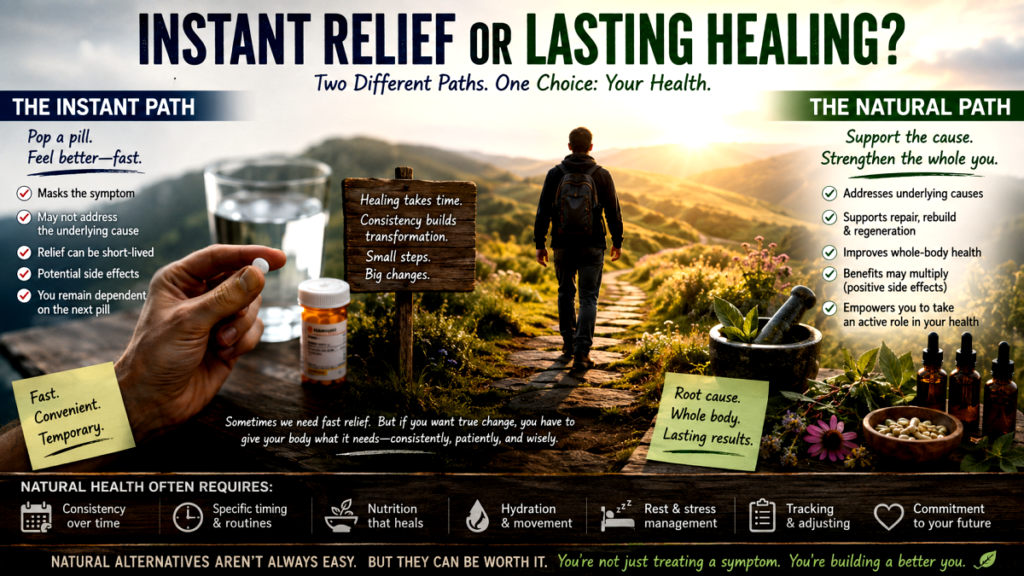
That’s wonderful when relief is what we need. But it also creates an expectation:

If something is working, shouldn’t I feel it right away?

That expectation can become one of the greatest obstacles people encounter when they begin exploring natural alternatives. Because natural approaches frequently aren’t trying to accomplish the same thing.

Relief and Repair Operate on Different Timelines

Imagine you’ve been living in a house for 30 years. One afternoon, you notice an ugly water stain spreading across the ceiling. You could paint over it. Twenty minutes later, you wouldn’t see the stain anymore.

Problem solved? Not exactly.

Someone interested in the underlying problem starts asking questions.

  • Where is the water coming from?
  • Is there a leaking pipe?
  • A roofing problem?
  • How long has it been leaking?
  • Is the insulation wet?
  • Has mold developed?
  • Has the wood begun deteriorating?

Suddenly, what looked like a twenty-minute paint job has become an investigation. And fixing the underlying problem takes longer.

That’s because covering evidence of a problem and repairing the conditions producing it are two different jobs.

This is one way to understand the patience sometimes required in natural health.

The Body Needs Time

The human body is constantly rebuilding itself. Cells are repaired and replaced. Tissues remodel. Hormones respond to changing conditions. Nutritional reserves can be depleted and replenished. Muscles strengthen with repeated use. Metabolic health can change. Sleep patterns can improve. The nervous system adapts.

None of this happens because we snapped our fingers. Biology operates on biological time.

If you’ve spent years creating—or simply living with—the conditions associated with poor health, it may be unrealistic to expect those conditions to change completely by Tuesday.

That’s frustrating. But it also makes sense.

Sometimes a Natural Protocol Is Inconvenient

This is another part we probably don’t talk about enough. A serious natural-health regimen can be a nuisance. Your personal program might involve one supplement with breakfast and dinner. Something else three times a day. Another intervention at bedtime.

Certain things with food. Others away from food. Perhaps dietary changes. More water. Movement. Sunlight. Better sleep habits. Tracking how you respond. And depending upon the particular approach being followed, there may be interventions performed at particular intervals throughout the day.

That is considerably more complicated than:

Take one tablet once a day.

No wonder people sometimes lose interest.

Natural-health enthusiasts occasionally talk as though everybody should naturally be excited about doing all this. They’re not. People have jobs. Children. Appointments. Bills. Responsibilities. They forget things. They’re tired.

Convenience matters. That’s one of the enormous advantages of modern pharmaceutical medicine: it has become extraordinarily good at making many interventions simple.

Natural approaches often ask considerably more participation from the individual.

“How Long Do I Have to Do This?”

This is one of the questions I’ve heard again and again:

“How long do I have to keep doing this?”

I’ve always found the wording fascinating. There’s something hidden inside it.

When will my sentence be over?

When can I stop doing this annoying thing and return to normal?

And certainly, some protocols are temporary. Some supplements or interventions should only be used for a particular period, and some can become inappropriate or harmful when continued indefinitely. But other health practices raise a different question.

If something is safe for you, sustainable, and genuinely improving your quality of life, why is stopping automatically the goal?

Nobody asks:

“How long do I have to keep drinking water?”

“How many more months do I have to sleep?”

“When can I finally stop eating nutritious food?”

“When will I have exercised enough that I never need to move again?”

We understand intuitively that certain things aren’t treatments. They’re part of caring for a human body.

Maybe We Need a Better Question

Instead of:

“How long do I have to do this?”

perhaps ask:

“What is this doing for me?”

    • Is my energy improving?
    • Am I sleeping better?
    • Is my mobility changing?
    • How is my digestion?
    • What are my objective health markers doing?
    • Am I stronger?
    • Do I recover more easily?
    • Has my quality of life improved?
    • Are there adverse effects?
    • Is this still necessary?
    • Could the regimen now be simplified?

Those questions turn obedience into participation. You’re no longer serving the protocol.

The protocol is supposed to be serving you.

That’s an important distinction.

Persistence Doesn’t Mean Blind Persistence

There is another side to this.

Natural-health people can become so committed to the idea that “healing takes time” that they continue something indefinitely even when it isn’t helping. That’s not persistence. That’s attachment.

If an approach isn’t producing the expected changes, investigate.

  • Maybe the dose or timing is wrong.
  • Maybe the original assumption was wrong.
  • Maybe you’re missing another piece.
  • Maybe the product isn’t what you thought it was.
  • Maybe the condition requires testing.
  • Maybe something else entirely is happening.

And sometimes the appropriate next stop really is a physician. Patience should never become an excuse for ignoring deterioration.

Give the body time—but keep paying attention to the body.

The People Who Stay With It Understand the Trade

People who become enthusiastic about natural alternatives often eventually understand something that beginners don’t.

They’re no longer looking only for the fastest way to stop feeling something. They’re investing in the condition of the body itself.

  • Nutrition.
  • Strength.
  • Sleep.
  • Movement.
  • Metabolic health.
  • Stress regulation.
  • Healthy aging.
  • Resilience.
  • Recovery.

Those things are built through repetition. And repetition requires persistence. The payoff isn’t necessarily a dramatic sensation ten minutes after swallowing something.

Sometimes the first evidence is almost disappointingly ordinary.

  • You sleep through the night.
  • You realize you haven’t had that afternoon crash lately.
  • The stairs seem easier.
  • You’re thinking more clearly.
  • You wake up before the alarm.
  • Something that used to bother you every morning hasn’t bothered you for three weeks.

Then one day you realize:

I feel better than I used to.

We May Be Asking the Wrong Thing of Our Bodies

We live in an instantaneous culture. Instant messages. Instant purchases. Instant entertainment. Instant answers. So naturally, we want instant health. But the body isn’t an app.

  • It is alive.
  • It adapts.
  • It repairs.
  • It responds.
  • It changes according to what we repeatedly give it and repeatedly ask of it.

Sometimes immediate relief is exactly what we need. But when we’re trying to improve the underlying conditions associated with health, the better question may not be:

“How fast can I make this feeling disappear?”

It may be:

“What can I consistently do that gives my body better conditions in which to function?”

Then do that.

  • Pay attention.
  • Adjust when necessary.
  • Measure what can be measured.
  • Keep what genuinely helps.
  • Discard what doesn’t.

And give biology something our instantaneous world doesn’t particularly like giving anything anymore:

Time.
 

Categories
Blog

DIY Natural Alternatives vs. Doctor-Managed Care: What’s the Difference?

“Doctor, it hurts when I do this.” For most of us, that’s a perfectly reasonable reason to make an appointment. Something hurts. Something isn’t working correctly. We can’t sleep. Our stomach is upset. Our joints ache. We’re exhausted. We have a rash, headache, infection, inflammation, or some other complaint that is interfering with life. We want it fixed. And modern medicine can be remarkably good at this.

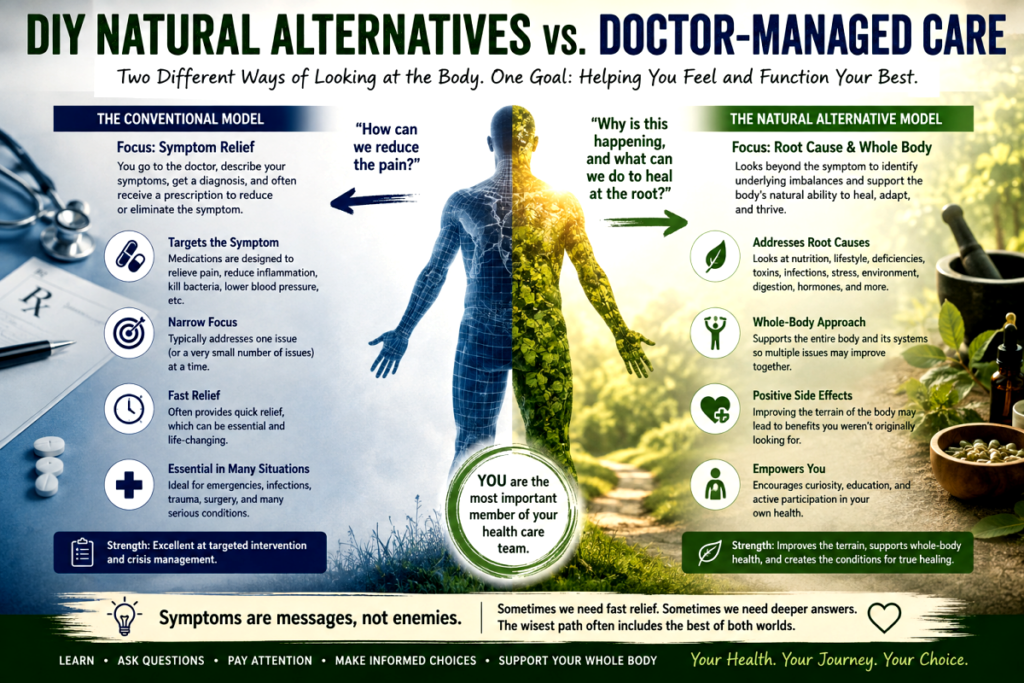
You walk into an office with a problem. The physician evaluates you, perhaps orders tests, reaches a diagnosis, and may prescribe something intended to relieve the symptom or treat the diagnosed condition. Sometimes that is exactly what we need. But the natural-alternative mindset often begins with another question:

Why is this happening?

That one question can send us down an entirely different road.

Symptom Relief and Root-Cause Thinking

Suppose your hip hurts. There are several perfectly legitimate ways to approach that complaint. One approach asks:

How can we reduce the pain?

Another asks:

What is producing the pain?

And a more expansive natural-health approach may ask:

What is happening throughout this person’s body that might be contributing to the conditions in which this pain developed?

Those aren’t necessarily competing questions. The problem comes when we answer only the first one.

Pain relief can be tremendously valuable. Nobody gets extra points for suffering unnecessarily. But removing the sensation of pain isn’t necessarily the same thing as changing whatever produced the pain.

That distinction is fundamental to understanding the DIY natural-alternative approach.

The Body Isn’t a Collection of Independent Parts

One of the most attractive ideas in natural health is remarkably simple:

Everything is connected.

Your hip isn’t living an independent life. Neither is your digestive tract. Neither is your immune system, circulatory system, nervous system, endocrine system, liver, kidneys, brain, muscles, or microbiome. They’re participating in the same biological environment.

This is why the natural-alternative investigator frequently becomes interested in things that initially seem unrelated to the presenting complaint.

    • What are you eating?
    • How are you sleeping?
    • How much are you moving?
    • How well are you hydrated?
    • What’s happening with digestion?
    • What nutrients might be missing?
    • What medications and supplements are you taking?
    • What environmental exposures are present?
    • What’s happening with stress?
    • What changed before the problem began?

Instead of asking only, “What can make this symptom stop?” we begin looking at the person who is experiencing the symptom. That is a very different investigation.

Becoming the Investigator of Your Own Body

This is where DIY natural health becomes fascinating. You start researching one problem and discover an entire world you didn’t know existed. Maybe you begin because your knees hurt. Then you learn about inflammation. That leads you to nutrition. Nutrition leads you to blood sugar. Blood sugar leads you to sleep. Sleep leads you to hormones. Hormones lead you to stress. Stress leads you to the nervous system.

Before long, the person who originally wanted nothing more than to make a knee stop hurting has begun examining how they live.

That doesn’t mean every theory they encounter will be correct. It doesn’t mean every supplement works. And it certainly doesn’t mean every health problem can be solved at home.

It means something much simpler:

Curiosity has replaced passivity.

You have become a participant in your own health.

The Curious Case of “Positive Side Effects”

Here’s something I’ve heard repeatedly over years of conversations with people involved in natural and alternative health.

Someone changes something because of one complaint. But something else improves. Then something else.

Maybe someone begins a nutritional program because they’re concerned about joint discomfort and later reports that they’re sleeping better.

Someone changes their diet for digestive reasons and notices that their afternoon fatigue disappears.

Another person addresses nutritional deficiencies and reports improved energy, mood, or exercise tolerance.

Sometimes people describe surprisingly dramatic changes in problems they weren’t originally trying to address. I think of these as positive side effects.

That phrase makes people smile because we’re accustomed to hearing the opposite.

We see advertisements for medications followed by long lists of possible adverse effects. But when someone improves the nutritional or physiological environment of the body, it isn’t particularly surprising that the effects may be experienced in more than one place.

That doesn’t prove that every improvement was caused by the intervention. Human biology is complicated, and personal reports aren’t controlled clinical trials. But the phenomenon is interesting enough to pay attention to. Especially when you’re the person experiencing it.

Targeted Intervention vs. Improving the Terrain

Pharmaceutical medicine frequently excels at targeted intervention. That’s one of its strengths. If a specific organism is causing an infection, for example, an appropriate antimicrobial drug may be selected because of its activity against that organism.

If blood pressure is dangerously high, medication may lower it. If inflammation is causing serious damage, controlling that inflammation can be enormously important.

Natural-health approaches often think somewhat differently.

Rather than targeting only one biochemical pathway, organism, or symptom, many natural approaches attempt to improve what practitioners sometimes call the body’s terrain—the overall physiological environment in which health or disease is occurring.

That might involve nutrition, micronutrients, sleep, movement, hydration, metabolic health, digestive function, stress regulation, or particular herbs and natural substances. And because those things aren’t confined to one body part, improving them may influence several systems simultaneously.

This is one reason people sometimes report benefits they weren’t looking for.

Natural Doesn’t Automatically Mean Safe

There is an important responsibility that comes with becoming your own investigator. “Natural” isn’t synonymous with “harmless.” Nature contains extraordinarily powerful chemistry.

Herbs can interact with medications. Nutrients can be taken in excessive amounts. Natural substances can be inappropriate for certain medical conditions. And symptoms that appear minor can occasionally be warning signs of something requiring immediate medical attention.

So DIY natural health shouldn’t mean:

I don’t need doctors anymore.

A much more useful philosophy is:

I want to become an informed participant in my health instead of outsourcing every decision about my body.

Those are very different positions.

Doctors and Natural Alternatives Don’t Have to Be Enemies

This may be particularly important today. There are people in the natural-health community who distrust conventional medicine profoundly.

Some have reasons rooted in difficult personal experiences. Others object to pharmaceutical influence, short appointment times, fragmented specialties, or a healthcare system that can sometimes feel better designed for managing disease than cultivating health.

Those concerns deserve discussion. But we don’t have to turn doctors into villains to recognize limitations in the system.

I’ve met wonderful physicians. I’ve also encountered natural-health practitioners whose confidence greatly exceeded their knowledge. Neither white coats nor herbs confer infallibility.

The useful question isn’t:

Which team are you on?

It’s:

What does this person need?

Sometimes the answer may be emergency medicine. Sometimes surgery. Sometimes antibiotics or another prescription. Sometimes nutrition. Sometimes movement. Sometimes rest. Sometimes correcting a deficiency. Sometimes an herb or another natural intervention. And sometimes the wisest answer is a combination.

Don’t Just Silence the Messenger

Symptoms are unpleasant. Naturally, we want them gone. But sometimes a symptom is also information.

Pain says something. Fatigue says something. Digestive trouble says something. Insomnia says something. Recurring headaches say something.

The message may be simple or complicated. It may have one cause or several. And sometimes extensive investigation still doesn’t reveal a satisfying explanation. But there is value in remaining curious.

Instead of asking only:

“What can I take to make this stop?”

we can also ask:

“Why might my body be doing this?”

And then:

“What does my body need in order to function better?”

That shift—from fighting the symptom to becoming curious about the person experiencing it—is one of the most valuable contributions of the natural-health philosophy.

It doesn’t require abandoning medicine. It doesn’t require believing every alternative claim. And it doesn’t require handing your judgment over to another authority, conventional or alternative.

It simply means becoming more engaged.

  • Learn.
  • Ask questions.
  • Pay attention to patterns.
  • Notice what changes.
  • Keep good records.
  • Use appropriate testing when it’s useful.
  • Seek qualified help when you need it.

And perhaps most importantly:

Don’t become so focused on making one symptom disappear that you forget the extraordinary biological system that’s trying to communicate with you.

The goal isn’t merely to feel less sick.

Whenever possible, the greater goal is to help the whole person become healthier.