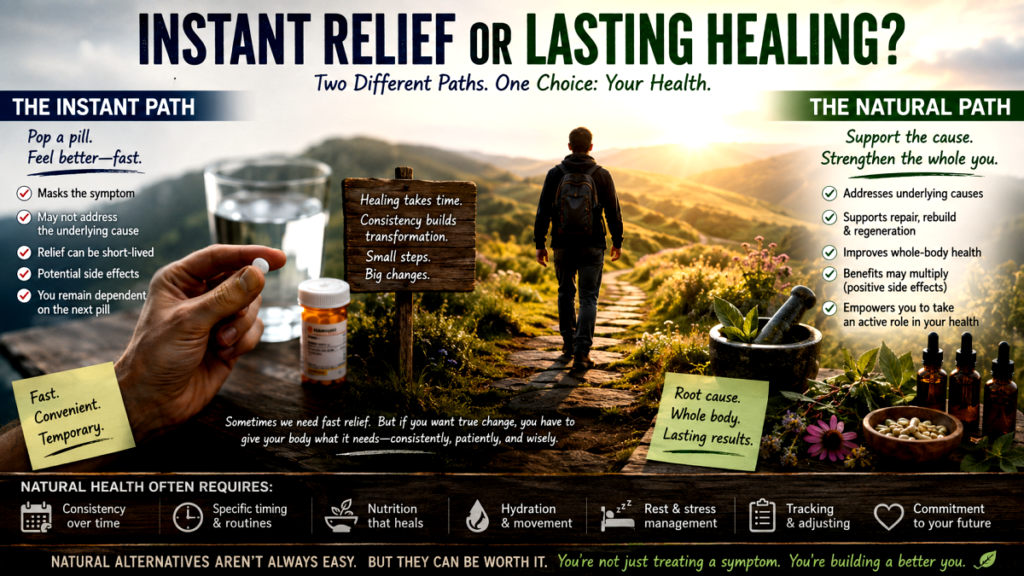
Healing isn’t just something you do. Sometimes it becomes a different way of living. Something interesting happens when you spend enough time around people who have dramatically changed their health. Eventually you notice that the most remarkable transformations frequently aren’t about what someone took. They’re about what someone became.
The person may have started with a supplement. A dietary change.An exercise program. A natural-health protocol. A frightening diagnosis. A book. A conversation. A moment when they looked in the mirror and realized:
I cannot keep living like this.
Whatever started it, somewhere along the way the project became bigger than the original complaint. Their life began changing. And that, I believe, is where things get really interesting.
We Want Different Results Without a Different Life
Human beings have an understandable tendency. We want the problem removed. But we’d really rather keep everything else.
Fix my blood sugar, but don’t touch my diet.
- Help my cardiovascular health, but don’t make me move.
- Give me energy, but don’t interfere with my sleep schedule.
- Help my digestion, but let me continue eating whatever I want.
- Lower my stress, but don’t ask me to reconsider the environment producing it.
- Help my body—but please leave my life alone.
Sometimes we can get away with that. Sometimes we can’t. Because the body we’re trying to change is living inside the life we’re refusing to change.
“See? I Knew It Wouldn’t Work.”
I’ve watched variations of this happen. Someone has a significant health problem. They get serious. Maybe they change their diet dramatically. Lose weight. Exercise. Follow a natural-health regimen. Work closely with a healthcare professional.
Their numbers improve. Their symptoms improve. In some cases, a condition such as type 2 diabetes may even go into remission.
They’re thrilled. Then something happens. They begin drifting.
A little of the old diet comes back. Then more. Exercise disappears. Sleep deteriorates. Weight returns. The protocol gets abandoned. The new habits gradually become old memories.
Months later, their health markers begin moving in the wrong direction again. And then comes the declaration:
“See? I knew it wouldn’t work.”
Wait a minute. Maybe it did work. Maybe that’s precisely what the period of improvement demonstrated.
The more useful question might be:
What changed when your health improved—and what changed again before the problem returned?
That’s a much more interesting investigation.
Your Body Is an Environment
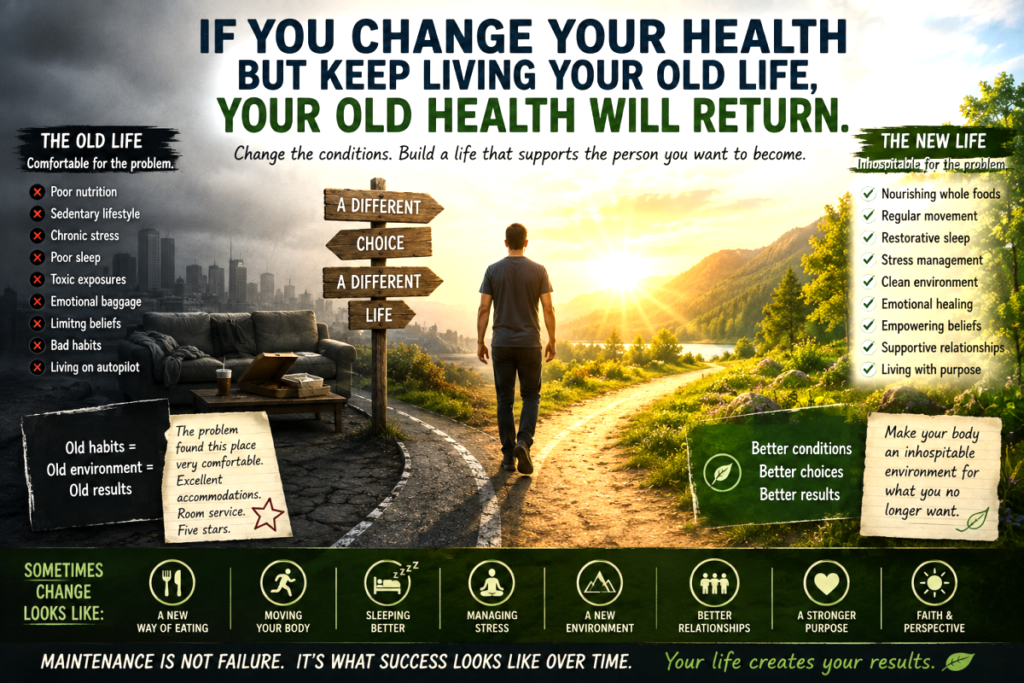
Here’s a metaphor I’ve used when talking about this. Imagine that a particular health problem has found your body to be a very comfortable place to live. Excellent accommodations. Everything it likes is already there.
Room service. Fresh towels. Turn-down service every night. Five stars.
Then you make changes. You alter the environment. Perhaps you improve metabolic health. Change nutrition. Become physically active. Correct a deficiency. Sleep differently. Reduce alcohol. Stop smoking. Lose excess body fat. Gain needed muscle. Address chronic stress. Follow an appropriate treatment or natural-health program.
Whatever combination applies to you, the environment begins changing.
The old problem may no longer find the accommodations quite so comfortable.
That’s useful. But here’s the part people sometimes miss:
If you rebuild the hotel exactly as it was before, don’t be surprised when the old guests check back in.
Make the Old Pattern Less Welcome
I sometimes describe this as making the body an inhospitable environment for the condition we’re trying to leave behind.
That isn’t a literal description of every disease process, of course. Diseases have different causes, and plenty of illnesses occur despite excellent lifestyles. But as a lifestyle principle, the metaphor is valuable.
If a condition is influenced by modifiable factors, change the factors you actually can.
Create better conditions. Better nutrition. Better metabolic health. Better sleep. Better movement. Better strength. Better recovery. Better stress management. Better relationships. Better environmental exposures where possible. Better medical care when needed. Better natural support when appropriate. Better decisions.
Not perfection. Better conditions.
Sometimes the Change Is Bigger Than Food and Exercise
This is where I’ve seen some extraordinary personal transformations. People sometimes assume a health journey means eating vegetables and joining a gym.
Sometimes it does. But sometimes the metamorphosis reaches much further.
Someone changes careers. Someone leaves an environment that has been crushing them. Someone moves to another part of the country. Someone discovers faith—or rediscovers it. Someone begins spending time outdoors. Someone ends a destructive relationship. Someone repairs an important relationship. Someone stops drinking. Someone learns to cook. Someone starts lifting weights at 60. Someone finally begins sleeping eight hours. Someone loses weight. Someone who has been undernourished gains needed weight and muscle.Someone stops making the same decisions they’ve made for thirty years.
Their entire life begins looking different. Why? Because somewhere along the way they stopped asking:
“How do I get rid of this problem?”
and started asking:
“What would my life look like if health actually mattered to me?”
That’s a much bigger question.
The Metamorphosis
I think metamorphosis is the right word. Because sustainable change can eventually affect identity.
- At first, you’re forcing yourself to go for a walk. Later, you’re someone who walks.
- At first, you’re forcing yourself to eat differently. Later, that’s simply how you eat.
- At first, you’re trying desperately to remember your health regimen. Later, taking care of yourself is part of your ordinary day.
- At first, you’re trying to become healthier. Eventually you begin thinking: I’m a person who takes care of my body.
That’s an enormous transition. Because willpower is exhausting.
Identity is different. Once the new behavior becomes part of who you are, you’re no longer negotiating every decision from scratch.
You Don’t Have to Become a Health Fanatic
This doesn’t mean your entire existence needs to revolve around wellness. You shouldn’t need seventeen alarms telling you when to swallow something for the rest of your life.
You don’t have to live at the gym. You don’t need to become afraid of restaurants. You don’t have to turn every meal into chemistry homework. And you certainly don’t need to become the person at every family gathering explaining what’s wrong with everybody else’s food.
The goal is not obsession. The goal is creating a life that naturally supports the person you’re becoming.
That’s very different.
Some Things Are Outside Our Control
There’s also an important humility required here. Lifestyle isn’t everything. Genetics matter. Age matters. Infections happen. Accidents happen. Environmental exposures matter.
Autoimmune diseases, cancers, neurological disorders, congenital conditions, and many other illnesses cannot simply be reduced to somebody’s lifestyle choices.
Healthy people get sick. People who do everything “right” can still develop serious disease. So this philosophy should never become a weapon for blaming sick people.
The useful question isn’t:
“What did you do to cause this?”
It’s:
“What can we influence from here?”
Sometimes the answer is a lot. Sometimes it’s very little. Either way, we work with what we have.
Maintenance Is Not Failure
This may be one of the biggest mindset changes of all. People sometimes believe that if something truly “worked,” they should eventually be able to stop doing everything that helped them and remain exactly the same. But why would that necessarily be true?
- If exercise made you stronger, stopping exercise doesn’t prove exercise failed when you eventually become weaker.
- If changing your diet improved a metabolic problem, returning permanently to the previous diet doesn’t prove the nutritional change was fraudulent if the problem returns.
- If sleeping adequately improves how you function, going back to four hours a night doesn’t invalidate sleep.
Some improvements require maintenance because living organisms continuously respond to their environment.
Maintenance isn’t evidence of failure. Sometimes maintenance is simply what success looks like over time.
Don’t Just Change the Condition. Change the Conditions.
This is the lesson I keep coming back to. If something in your health needs to change, naturally you want to find the intervention.
The medicine. The supplement. The herb. The diet. The therapy. The protocol. The procedure. Whatever is appropriate.
But don’t stop your investigation there. Look around the intervention. Look at the life surrounding it.
- What are you repeatedly giving your body?
- What are you repeatedly asking it to endure?
- What helped during the period when things improved?
- What gradually disappeared?
- What returned before the old problem returned?
- What could become part of your life rather than merely part of your treatment?
Those questions may reveal something much larger than a protocol. They may reveal the next version of you. Because sometimes the greatest natural-health transformation isn’t discovering the perfect thing to take. It’s reaching the point where you genuinely want a different life badly enough to live differently.
And once that metamorphosis happens, you’re no longer waiting impatiently to finish your health program so you can get back to normal. You’re creating a new normal. A normal that supports where you’re going instead of continually rebuilding where you’ve been.
So remember:
If you change your health but keep returning to the life that helped sustain the old pattern, don’t be surprised when the old pattern returns.
Change the intervention when necessary. Change the protocol when necessary. But when your life itself is part of the equation—
change the conditions, too.