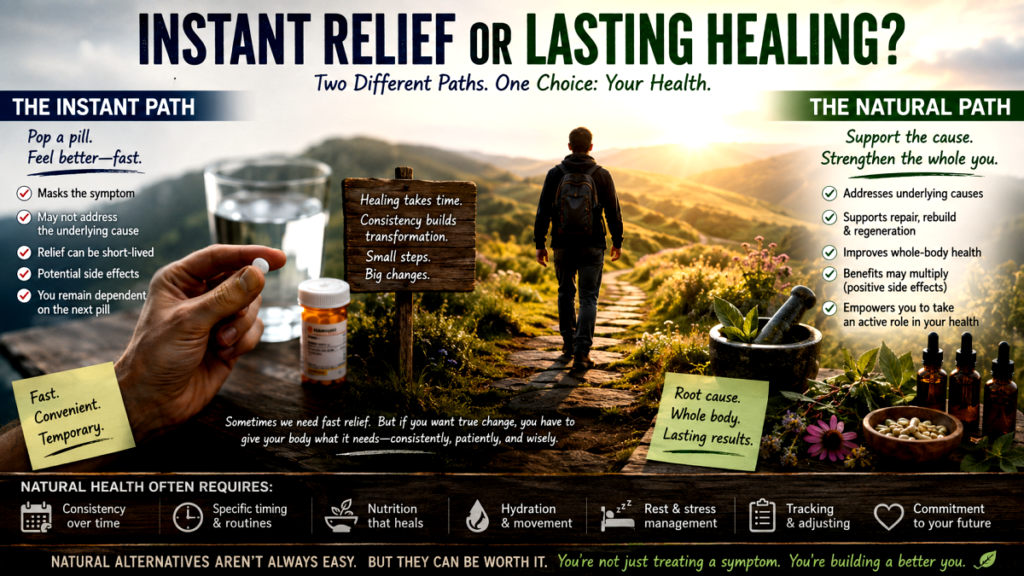
Finding something that worked doesn’t mean you’ve found the only thing that works. Something happens when people experience a dramatic improvement in their health. They get excited. Of course they do.
Imagine being told you’re facing a terrible prognosis. Imagine living with something you’ve been told is chronic, progressive, or unlikely to improve. Then you begin doing something different.
- Maybe you dramatically change your diet.
- Maybe you begin using an herb.
- Maybe it’s a nutritional protocol.
- Maybe it’s a medical treatment.
- Maybe it’s a natural-health regimen.
- Maybe you change twelve things simultaneously and have absolutely no idea which one mattered most.
But something happens. Your health improves. Perhaps dramatically. And suddenly you want to stand on a chair and announce:
“THIS IS IT!”
“I found it!”
“This is the answer!”
“This is the cure!”
I understand that enthusiasm. But after spending enough time around natural-health people, you eventually discover something humbling:
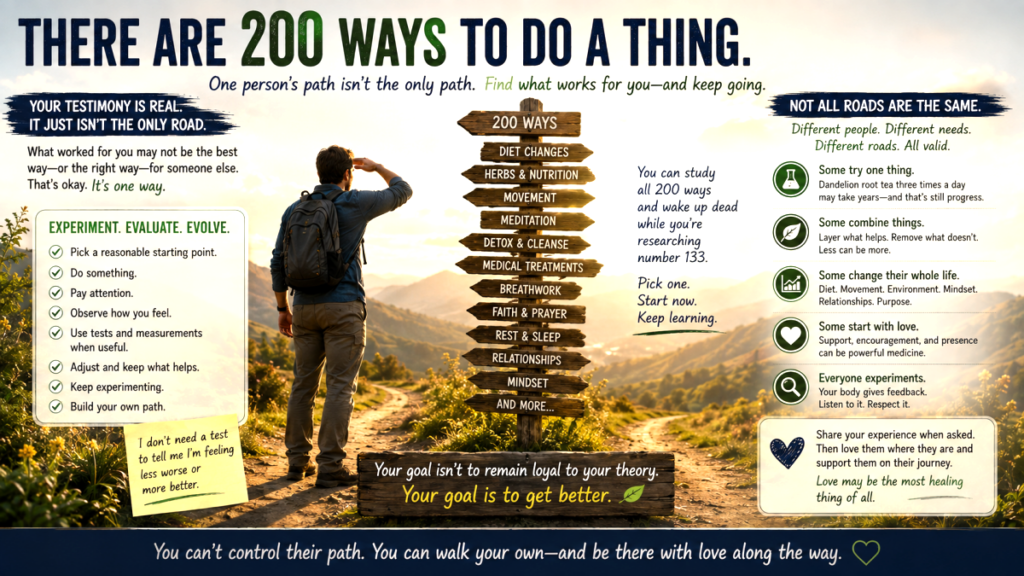
There are 200 ways to do a thing.
Your Testimony Is Real. It Just Isn’t Everybody’s Road Map.
Suppose you’ve experienced something extraordinary.
- Your doctors gave you a frightening prognosis.
- You went home.
- You investigated.
- You made changes.
- Months or years later, you’re doing remarkably well.
That’s your story. Nobody needs to take that away from you.
- If you experienced it, you experienced it.
- If your laboratory results changed, they changed.
- If imaging changed, it changed.
- If your symptoms disappeared, that’s what happened.
- If you’re still standing ten years after somebody predicted you wouldn’t be, you’re entitled to be rather enthusiastic about that.
But there’s a subtle leap we sometimes make:
“This worked for me.”
becomes:
“This works.”
And then:
“This is what everyone with this condition should do.”
Those are three different statements.
Your experience may have discovered one road. It doesn’t necessarily mean you’ve discovered the only road. And here’s an even more humbling possibility:
Your road might not even be the best road.
It may simply be the road you found. That’s okay. A road that gets you somewhere is still enormously valuable.
One Successful Experiment Should Make Us Curious
I actually think a successful personal experiment should make us more curious, not less.
Suppose someone drinks dandelion-root tea three times a day and over three years experiences the improvement they were hoping for.
Wonderful.
- Could something else have produced the same result? Possibly.
- Could another approach have done it in eighteen months? Maybe.
- Could something have accomplished it in six months?
We don’t know.
- Could the tea have been only one factor among several? Certainly possible.
- Could the improvement have occurred for reasons the person never identified? Also possible.
None of those questions require us to ridicule their experience. They simply keep curiosity alive.
Natural health becomes much less interesting when discovery turns into dogma.
The Problem With “The One Thing”
Human beings love singular answers.
- The food.
- The herb.
- The supplement.
- The detox.
- The exercise.
- The protocol.
- The doctor.
- The molecule.
- The cure.
One answer is comforting. Two hundred possibilities are messy. But biology is messy. Two people can receive the same diagnosis and have remarkably different histories.
- Different genetics.
- Different diets.
- Different nutritional status.
- Different microbiomes.
- Different medications.
- Different environments.
- Different exposures.
- Different stress loads.
- Different ages.
- Different sleep.
- Different activity levels.
- Different underlying conditions.
- Different resources.
- Different beliefs.
- Different willingness to change.
Why would we automatically expect every one of those people to follow precisely the same path?
Don’t Study Yourself to Death
Now we reach the other extreme. Once you realize there may be 200 ways to approach something, you can become paralyzed by possibilities.
You read about approach number one. Interesting. Then number two contradicts number one. So you investigate number three. Someone says number four changed their life. But a podcast tells you number seven is better. Then you find an online group devoted to number twenty-three. A practitioner tells you they’re all wrong and you need number forty-eight. Six months later, you’ve created a spreadsheet comparing 132 approaches.
You’re about to begin investigating number 133. And you’ve done absolutely nothing. At some point:
DO SOMETHING.
You can spend all your time studying the 200 ways to do a thing and wake up dead while you’re researching number 133.
That’s deliberately provocative. But the point matters. Research is useful.
Research without action can become another form of avoidance.
Pick a Reasonable Starting Point
You don’t have to know the perfect answer before beginning. Find a reasonable starting point. Evaluate the risks. Understand what you’re doing. Consider interactions and contraindications.
For serious medical conditions, know what can be objectively monitored and involve appropriate professionals where needed.
Then begin.
Not twenty things at once if you can avoid it. Something.
Pay attention. Keep records. What changed? What didn’t? How do you feel? What are your measurements showing? Are your symptoms improving? Are there unwanted effects? Are objective markers changing? Does something need adjusting?
That’s experimentation.
Feeling Better Matters
I deliberately like saying things such as:
“I don’t need a medical test to tell me I’m feeling less worse or more better.”
Yes, I know. Less worse. More better.
I said it that way on purpose. Because subjective experience matters.
- If you used to wake up exhausted and now you wake up refreshed, that’s information.
- If climbing the stairs hurt and now it doesn’t, that’s information.
- If you had headaches four days a week and haven’t had one in a month, that’s information.
- If you couldn’t sleep and now you’re sleeping seven hours, that’s information.
Your experience of living inside your body counts. But it isn’t the only information available.
Sometimes the Body Whispers While the Numbers Scream
This becomes especially important with serious conditions.
- You can feel perfectly fine while blood pressure is dangerously high.
- Blood glucose can be moving in the wrong direction before you recognize obvious symptoms.
- Some cancers can progress without announcing themselves through daily sensations.
- Kidney and liver problems can develop quietly.
So when reliable objective measurements exist, use them. That’s not surrendering your natural-health independence. That’s gathering more data.
If I’m experimenting, I want more information, not less.
- How do I feel?
- What does my body seem to be telling me?
- What does the laboratory work say?
- What does imaging show when appropriate?
- What changed before the improvement?
- What changed before deterioration?
All of it becomes part of the investigation.
Listen to your body—and use instruments when your body can’t tell you the whole story.
Build Your Own Road Carefully
This is where natural wellness can become deeply personal.
Maybe you discover that changing your diet helps. Keep it. Then you add something else and notice additional improvement. Keep investigating.
Maybe movement makes another difference. Maybe correcting a nutritional deficiency changes something. Maybe an herb does. Maybe better sleep produces a bigger improvement than the expensive supplement you were convinced would save the world.
Maybe something you were excited about does absolutely nothing. Fine. Let it go. Your goal isn’t to remain loyal to your theory.
Your goal is to get better.
That distinction can save you enormous amounts of time and money.
Combination Doesn’t Automatically Mean Better
There is one caution here. Once natural-health people discover several promising things, there’s a temptation to combine everything. If one is good, twelve must be spectacular. Not necessarily.
Natural substances contain active compounds. Supplements can interact with one another. They can interact with medications. More isn’t automatically better.
And when you change fifteen things simultaneously, you may have no idea which one helped—or which one caused a problem.
Experimentation should include restraint.
Add thoughtfully. Observe. Document. Adjust.
Your 200 Ways Aren’t My 200 Ways
Now we return to something important from our previous conversation. Suppose you found your thing. You’re excited. You tell me. Wonderful. But maybe I’m investigating something else.
Don’t be offended. Your thing may not be on my radar. Maybe I’ve already considered it. Maybe I’m not comfortable with it. Maybe I’m working with somebody whose approach differs from yours. Maybe something else makes more sense to me. Or maybe I’m simply not ready.
That doesn’t invalidate your experience. And my lack of interest doesn’t require you to intensify the sales pitch.
Remember:
Your testimony is an invitation, not an obligation.
Tell me what happened to you. Tell me what you learned. Answer my questions if I ask. Then allow me to cut my own path.
Sometimes Love Belongs in the Protocol
There is another natural intervention that doesn’t come in a bottle. Love. Support. Human connection. Hope. Being listened to. Having somebody beside you who isn’t constantly correcting you. Knowing somebody cares whether you make it.
None of that guarantees recovery from disease. But don’t underestimate what supportive relationships can mean to a human being going through something frightening.
Sometimes the most helpful thing you can offer isn’t another protocol. It’s presence.
“I’m with you.”
“I respect your decisions.”
“If you want to know what I did, I’ll tell you.”
“If you choose another road, I still love you.”
That may be more supportive than overwhelming somebody with another stack of research.
There Are 200 Ways to Do a Thing
I don’t know whether there are literally 200. Maybe there are twenty. Maybe two thousand. That’s not the point. The point is humility.
What worked for me is not automatically the only thing that can work for you.
So learn from other people’s experiences. Study. Ask questions. Use professional expertise where it’s useful. Pay attention to your own experience. Use objective measurements when they can tell you something your senses cannot.
Choose a reasonable starting point. Do something. Observe. Adjust. Keep what genuinely helps. Discard what doesn’t.
And never become so devoted to your favorite answer that you stop looking for better questions. Because finding a way is wonderful.
Just don’t confuse it with finding the only way.
There may be 200 ways to do a thing. You don’t have to investigate all 200 before you begin.
Find one reasonable road, start walking, and keep your eyes open along the way.