When a life-threatening diagnosis changes the questions people ask—and what hope, choice, and compassionate support mean when time is running out.
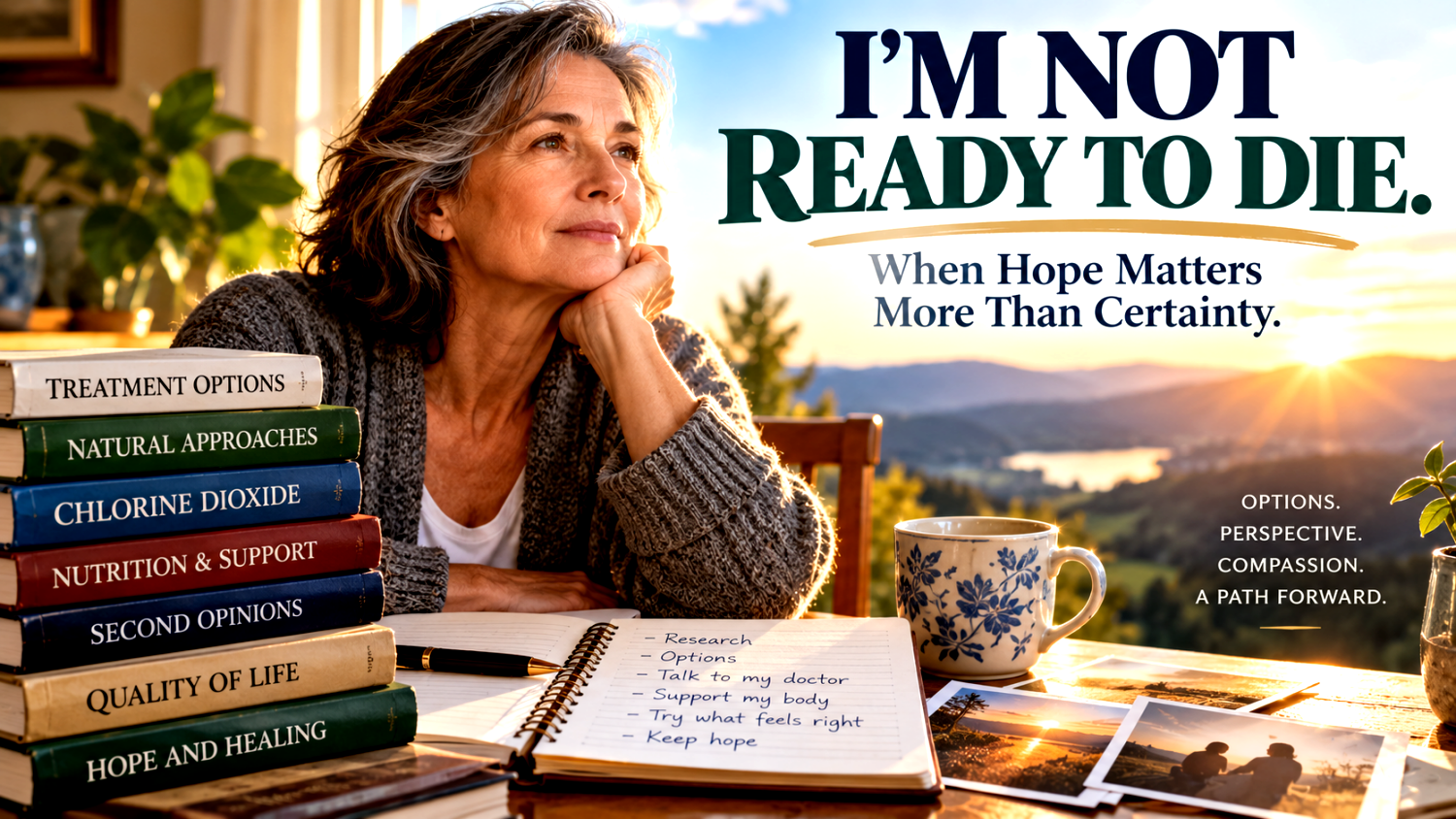
There comes a moment when the conversation changes.
You’ve been talking about research, mechanisms, clinical evidence, treatment outcomes, and which intervention might be responsible for which result.
And the person sitting across from you looks you straight in the eye and says:
“Who cares what does what? I’m going to die. I don’t have time for all those questions. Just tell me everything I could do, and I’ll do whatever I can.”
What do you say to that?
Because that isn’t necessarily someone rejecting science. That may be someone looking at a calendar that suddenly has an expiration date.
Someone who has been told that the treatment options are exhausted. Someone who has heard the words six months, terminal, or nothing more we can do.
Someone who still has people to love, things to experience, unfinished conversations, and reasons to wake up tomorrow.
For that person, the question may no longer be, “Can you prove which intervention works?” It may be something far more immediate.
“Is there anything left I can do?”
When the Clock Changes Everything
Most of us have the luxury of asking questions. We can compare studies, investigate mechanisms, review outcomes, and debate the relative merits of different approaches. But a life-threatening diagnosis can change the meaning of time.
Six months is no longer an abstract period. It’s birthdays. Anniversaries. Holidays. Sunsets. It’s wondering whether you’ll see another Christmas. It’s the realization that the life you’ve been living may be approaching its final chapter before you’re ready to finish the story.
And people respond differently.
Some become determined investigators. They read books, contact practitioners, explore clinical trials, change their diets, reconsider their habits, and pursue possibilities they might previously have dismissed.
Others turn toward peace.
They may decide they’ve had enough hospitals, procedures, appointments, and uncertainty. They may prefer to spend their remaining time with family, in familiar surroundings, or simply doing the things they love.
Neither response is universal. And neither response tells us how much a person values life.
“I’m Going to Do Everything It Says”
Imagine someone holding a book that discusses their particular diagnosis. They turn to the relevant chapter. They see a collection of suggested interventions—perhaps nutritional changes, supplements, minerals, oils, or substances such as chlorine dioxide.
And they say:
“I’m going to do everything it says, right here.”
A researcher might immediately ask which of those interventions has evidence of effectiveness, whether the ingredients interact, and how anyone could determine what helped.
Those are legitimate questions. But they may not be the questions that person is prepared to entertain. The person may have already heard that conventional treatment has nothing more to offer.
They may be thinking:
I’ve been given very little time. I don’t want to spend all of it debating possibilities. I want to do something.
This is a real human response to a frightening situation. It deserves to be understood before it is evaluated.
Yet understanding the urgency doesn’t mean every recommendation in a book is beneficial or harmless. Some combinations can cause injury, interfere with medications, or make the remaining time more difficult.
A compassionate response can honor the desire to act while helping the person distinguish options worth pursuing from those likely to create additional suffering.
The Difference Between Hope and a Guarantee
Hope is often misunderstood. Some people treat hope as though it requires certainty.
If an intervention cannot promise a particular outcome, they wonder whether it deserves consideration at all. But hope does not require a guarantee.
A person can understand that something may not work and still decide that pursuing a reasonable possibility matters deeply to them.
- They may find meaning in participating actively in their care.
- They may discover new relationships, a renewed sense of purpose, or unexpected peace.
- They may experience improvement.
Or they may not.
What matters is that hope need not depend entirely on the eventual medical outcome.
Sometimes hope means believing there may be more life ahead. Sometimes it means knowing that you still have a voice in what happens next.
Why Extraordinary Recovery Stories Matter
Stories of unexpected recovery have a special power. They offer a possibility that someone facing a terminal diagnosis desperately wants to believe might apply to them.
That helps explain the enduring appeal of Jim Humble’s accounts, chlorine dioxide testimonials, and the broader alternative-health literature.
People encountered stories in which someone appeared to improve after trying an approach outside conventional treatment. Some readers found those stories encouraging enough to explore additional options.
Others may have felt that they were finally being offered hope after hearing discouraging medical news. But the emotional power of a recovery story and the medical explanation for that recovery are separate questions.
A person may improve while using several interventions. Their condition may have been misjudged. A concurrent treatment may have contributed. Spontaneous improvement may occur. Or an intervention may deserve further investigation.
Without appropriate evidence, the cause cannot reliably be assigned. That uncertainty doesn’t erase the person’s experience. It simply means that a meaningful story should not become a guarantee for the next person.
Not Everyone Wants to Fight
There is another side to this conversation that deserves equal compassion.
Some people receive a terminal diagnosis and feel an unexpected sense of relief.
- They may be exhausted.
- They may have lived through years of illness, loss, pain, or struggle.
- They may not want another intervention.
- They may want to stop fighting.
That doesn’t necessarily mean they’ve lost hope. Their hope may have changed.
Instead of hoping for another decade, they may hope for a peaceful afternoon, a familiar voice, freedom from pain, or the opportunity to say goodbye.
It is possible to respect the person who wants to pursue every reasonable opportunity and the person who wants to pursue no further disease-directed treatment.
The central question is not whether someone is fighting hard enough. It is whether their wishes are being heard.
“Then Tell Me What I Can Still Do”
Perhaps the most compassionate response to someone facing a life-threatening diagnosis is not another argument. Perhaps it begins with listening.
- What are they hoping for?
- More time?
- Less pain?
- A chance to attend a wedding?
- Enough strength to travel?
- A final conversation?
- The possibility of recovery, however uncertain?
Their answer can help determine which options deserve attention.
Those options might include another specialist’s opinion, a clinical trial, symptom-directed treatment, nutritional support, rehabilitation, psychological or spiritual care, or a reconsideration of previously discussed treatments.
Palliative care can also be part of an active plan. It can support comfort and quality of life alongside disease-directed treatment, rather than replacing it.
And when someone wants to explore complementary approaches, a respectful conversation about benefits, uncertainties, interactions, and risks can help them make choices consistent with their goals.
The purpose is not to take away their agency. It is to help them use it.
Keeping Doors Open
One of the most valuable considerations in an uncertain situation is preserving future choices.
- A person might decide to explore an additional approach while continuing medical monitoring.
- They might seek another opinion before abandoning a treatment.
- They might decide which risks are acceptable and which would threaten the very quality of life they’re trying to preserve.
This does not require turning their final months into a research project. They do not have to become scientists.
They do deserve accurate information about what is known, what remains uncertain, and what could cause harm. Because there is a meaningful difference between taking a chance and unknowingly closing off another chance.
There Is More Than One Way to Be Brave
We often celebrate the fighter. The person who refuses to give up. The person who searches for one more possibility when everyone else seems ready to close the book.
That determination can be extraordinary. But there is courage in choosing peace, too.
There is courage in declining another treatment. There is courage in saying, “I want whatever time remains to belong to me.” And there is courage in admitting that you are frightened, uncertain, and still searching.
No one should have to earn compassion by choosing the kind of ending someone else admires.
The Question Behind the Question
When someone says, “I don’t care about the science,” we may hear a rejection of evidence. But sometimes the deeper message is:
- Please understand that I’m running out of time.
- Please don’t turn my remaining life into an argument.
- Please help me see whether I still have choices.
That is a request worth hearing.
- We can answer it without pretending every alternative treatment works.
- We can respect someone’s determination without endorsing every risk.
- We can acknowledge extraordinary recovery stories without promising extraordinary recovery.
- And we can offer practical help without demanding that a frightened person become a researcher.
Because sometimes the most important thing we can give someone is neither a miracle nor a lecture. It’s the experience of being heard, respected, and supported while they decide what to do with the life that is still theirs.
Hope deserves honesty. And honesty deserves compassion.
Editorial note: This article discusses personal responses to life-threatening diagnoses and the appeal of alternative treatments. It does not establish the safety or effectiveness of chlorine dioxide or other unproven interventions as medical treatments. Chlorine dioxide ingestion can cause serious harm. People considering complementary approaches should have access to accurate information, appropriate medical care, and support for their own treatment goals.